Book announcement from Majungmul Press
You can recognize the grammar in a Korean sentence and still miss the joke, the shortcut or the feeling behind it. Casual conversations and short online messages often bring a different kind of learning challenge: understanding what people mean in the moment.
Korean Your Teacher Doesn’t Teach You by Injin Hwang focuses on that everyday side of the language. Its subtitle, 300 Korean Slang Expressions, Abbreviations, and Everyday Phrases, introduces the book’s focus: Korean beyond the formal sentences learners first meet in class.
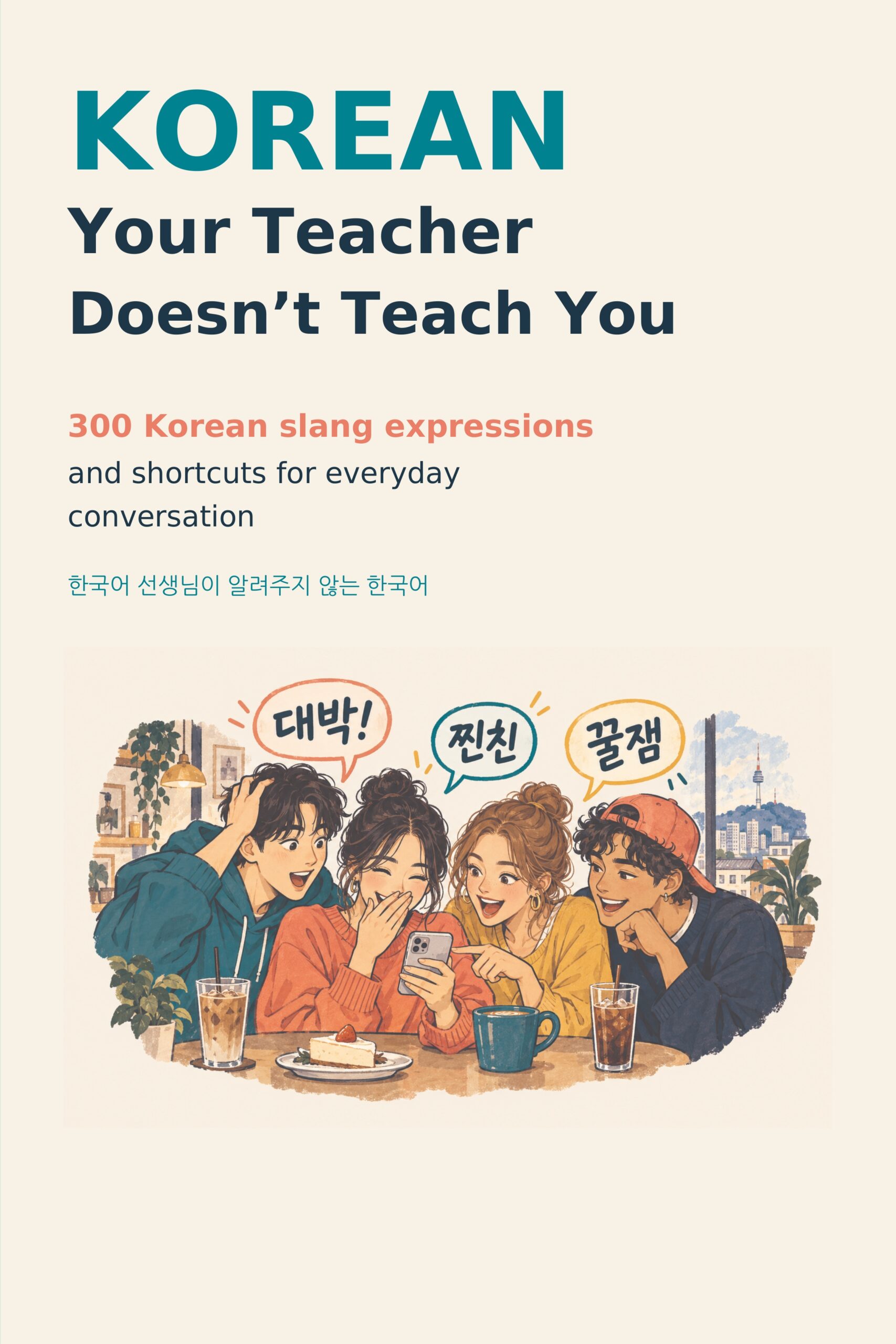
A Korean slang book for language outside the classroom
A formal lesson gives you a valuable foundation. Everyday language adds another layer: abbreviated messages, playful reactions and expressions whose meaning depends on the relationship between the speakers. This book brings 300 slang expressions, abbreviations and everyday phrases into one collection for learners interested in that layer.
The aim is to make room in your learning routine for the Korean you encounter in conversations, entertainment and online exchanges. Knowing an expression also gives you a reason to notice who uses it, how it sounds in context and whether it suits the situation.
Who might enjoy this book?
- Korean learners who want to explore informal expressions alongside their regular studies.
- Readers curious about the language of casual conversations and short messages.
- Korean culture fans who enjoy noticing how people react, joke and connect through language.
- Independent learners looking for a focused collection of everyday expressions to return to gradually.
A thoughtful way to study everyday expressions
Rather than trying to memorize a large list at once, choose a few expressions and pay attention to them when you meet them again. Keep a small note of the situation: who was speaking, how close the speakers seemed and what reaction the expression produced.
Understanding an informal phrase does not mean you need to use it immediately. Recognizing it first can be useful in its own right. When you do try a new expression, consider the setting and ask a trusted speaker if the tone fits. Slang can be playful among friends and unsuitable in a more formal exchange.
These are study suggestions from Majungmul Press, not a promise that one book replaces broader language practice. Combine your reading with listening, conversation and the grammar you are already learning.
Book details
- Title: Korean Your Teacher Doesn’t Teach You
- Subtitle: 300 Korean Slang Expressions, Abbreviations, and Everyday Phrases
- Author: Injin Hwang
- Formats: See the Amazon listings below for current options.
Where to find the book
Choose the listing that matches the edition you want. Check Amazon for the current format, price, and availability in your region.
View the Kindle edition on Amazon
View the Korean slang book on Amazon
Continue exploring Korean language and culture with our guide to the different meanings of gwaenchanayo and guide to Korean names.