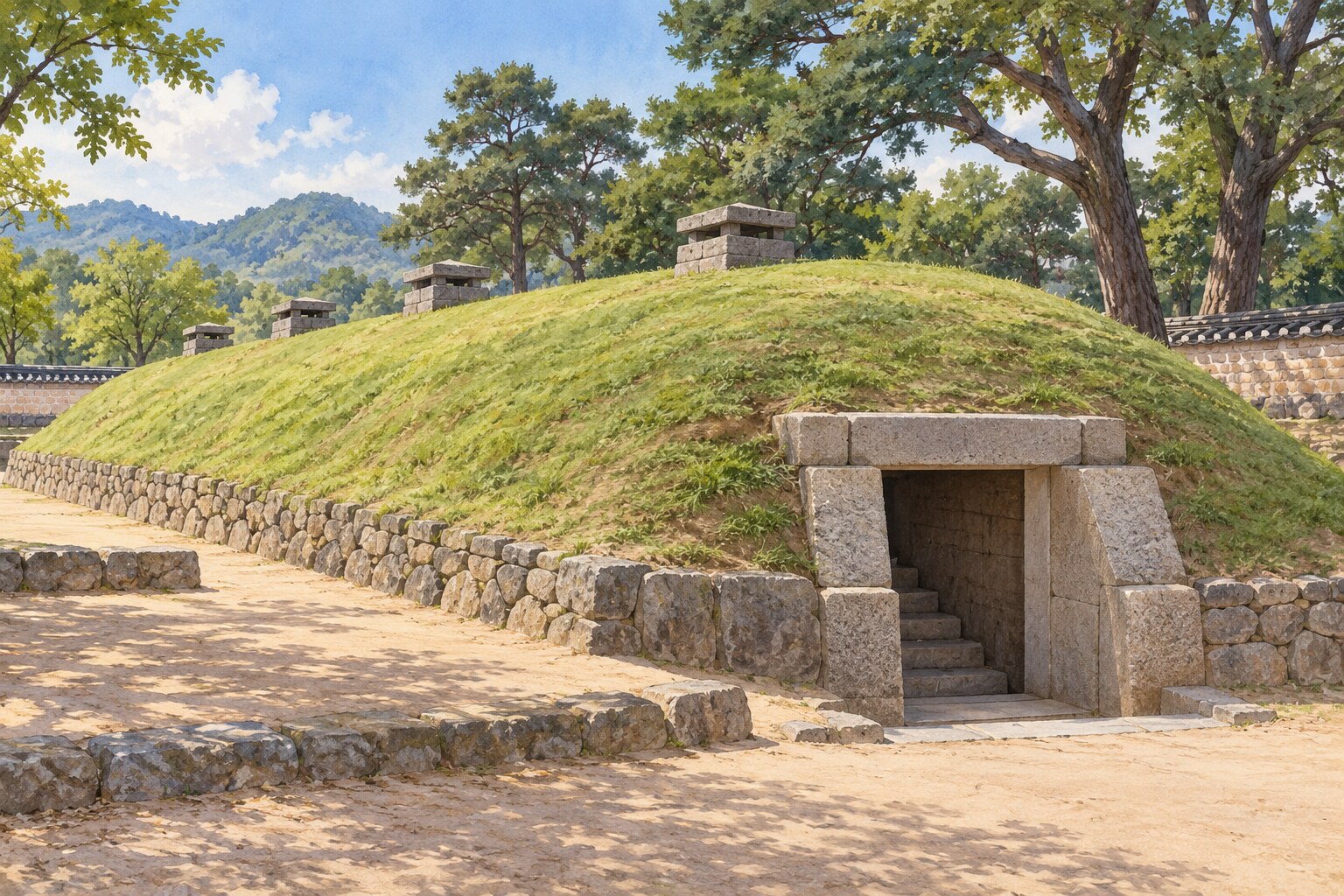
A low grassy mound with a stone entrance is easy to pass without much curiosity. Yet a seokbinggo (석빙고) poses a remarkable question: how could people use winter ice during the summer, long before electric refrigerators? The answer begins with storage rather than ice-making.
It preserved ice brought in from outside
Seok refers to stone, while binggo means an ice store. According to the National Institute of Korean History, ice was cut from frozen water in winter and transported into storage. The chamber’s job was to slow the loss of that ice until it was needed.
Keeping that distinction in mind avoids a common misunderstanding. Calling the building an old refrigerator is a helpful comparison, but it did not manufacture cold through an electrically powered system. People had to collect the seasonal resource and move it into place first.
Several architectural features worked together
The institute describes a partly underground chamber, a protective covering above, ventilation shafts and a sloping floor with drainage. The underground position helped moderate temperature changes, while the sloping floor carried away meltwater. Ventilation formed another part of the storage design.
Rather than treating one feature as a magical secret, think about the different problems involved: outside warmth, water from melting ice, and the practical movement of heavy blocks. The building is interesting because its parts respond to a shared task.
Cold storage also required people and organization
The institute’s account describes the work of cutting and transporting ice, as well as its allocation to institutions and people. During the Joseon period, stored ice was used for purposes including state ceremonies and the royal household.
That history invites a different question from “How cold was the room?” Ask who did the collecting, who maintained the building and who decided where the ice went. A storage chamber can tell a story about labor and access to resources as well as architectural ingenuity.
Looking at a surviving example
Gyeongju’s seokbinggo is listed by the Korea Tourism Organization in Inwang-dong. Its modest exterior is a reason to read the interpretation carefully. A low mound does not advertise its original function as clearly as a palace gate or a tower.
If you visit, distinguish the age of the ice-storage tradition from the construction date of the particular building. A city’s ancient history does not make every structure within it equally old. Use the site’s own identification and explanation rather than assigning a date from the surrounding scenery.
A short observation guide
- Start with the label: Confirm which structure you are looking at and what is known about its history.
- Notice the entrance: Consider how the approach connects the outside ground level to the chamber.
- Look at the covering: Observe the relationship between the earth above and the stone construction.
- Use interpretation for hidden features: A diagram or official explanation can show drainage and interior details that are not visible from the visitor route.
Do not assume that an entrance means you may go inside. Follow barriers and current site instructions, and avoid climbing onto the mound or ventilation structures. You can understand a great deal from the permitted viewing area.
A different way to notice Korean heritage
After learning about seokbinggo, look for the practical questions behind other historical buildings. What did people need to keep warm, cool, dry or protected? Our hanok stay guide begins with the experience of sleeping in a traditional-style house; an ice store directs your attention to a very different use of space.
The memorable part is not simply that people managed without electricity. It is how much planning can be contained in a building that, from the path, looks so quiet.
Sources: National Institute of Korean History: Seokbinggo, or Stone Ice Storage; VISITKOREA: Gyeongju Seokbinggo. Featured image: original AI-generated conceptual illustration; it is not a measured reconstruction of a particular monument.