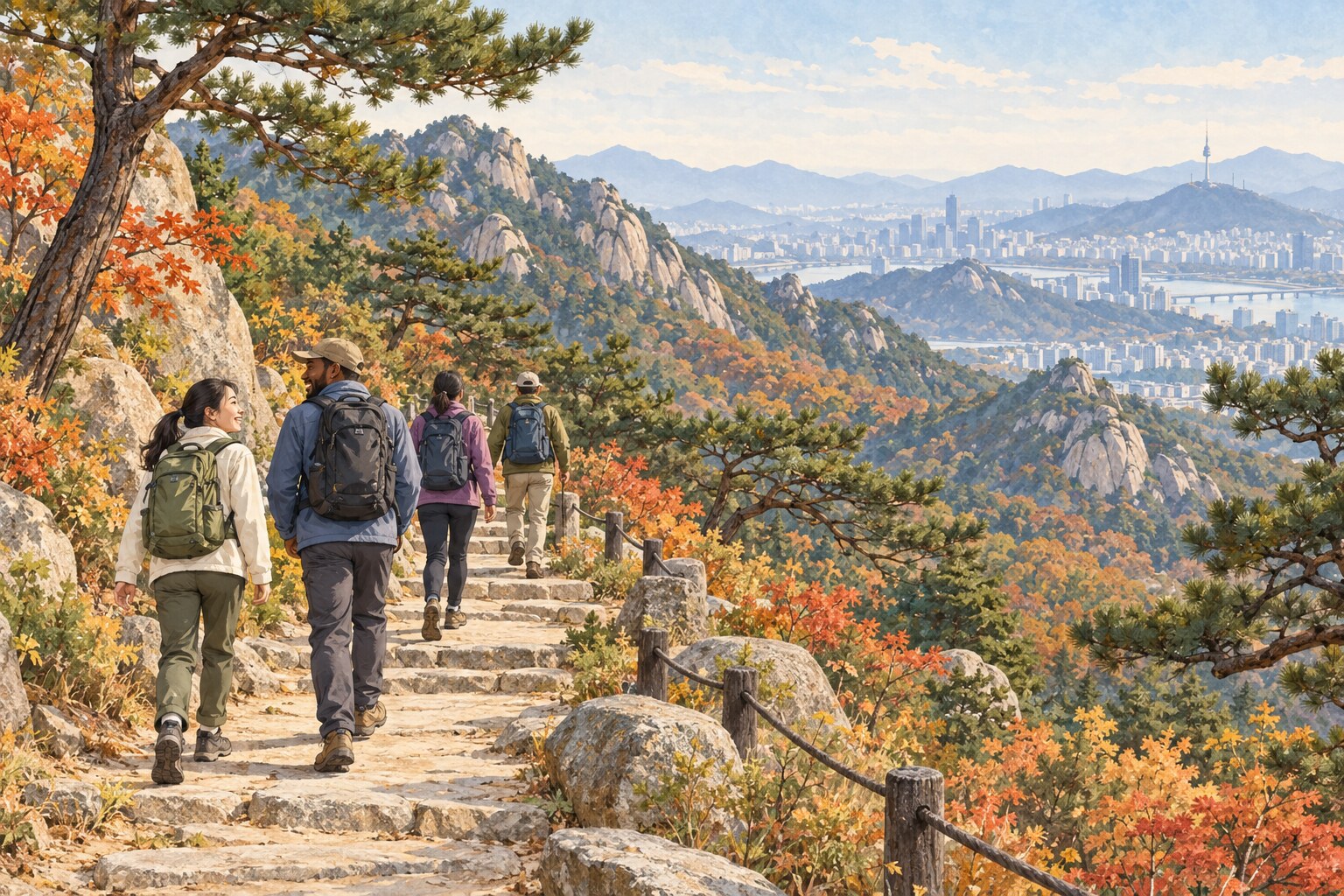
Hiking in Korea can bring a surprising change of pace to a city trip. A morning may begin near shops and apartment buildings and continue among trees and granite slopes. The important planning decision is the particular route you choose: a mountain’s name alone tells you very little about the walk ahead.
Why hiking fits into a Korean city visit
Korea Tourism Organization highlights Seoul hiking routes that connect urban travel with mountain scenery. Public transport can make some trailheads convenient to reach. That accessibility does not make every route gentle, short, or suitable for your group.
Treat the outing as its own activity. If you already have a full day of sightseeing planned, adding a summit simply because it appears nearby on a map can turn a pleasant excursion into a rushed one. A shorter forest walk may fit your time and interests better.
Choose a route, not just a famous mountain
Before committing, identify the starting point, endpoint, distance, ascent, surface, and expected walking time. Check whether the suggested time is one way or return. Two routes on the same mountain can involve very different amounts of climbing.
A loop returns to its starting area, while a point-to-point route finishes somewhere else. An out-and-back route means retracing your path. Save the correct trailhead location and the intended return transport, especially if a mountain has several entrances.
Look for a route description from the park or local tourism authority. Terms such as “beginner” are relative; inspect the actual terrain and elevation information. Trails called dulle-gil often go around an area rather than targeting a summit, but they can still have hills and long sections.
Check conditions before leaving
Read the park’s current access notices and local weather forecast. Seasonal restrictions, maintenance, heavy rain, snow, ice, and strong wind can affect a route. Some destinations or routes have entry controls or reservation requirements, so use information for the specific trail.
Plan to finish in daylight with time to spare. Count breaks and the descent, not only the climb. If conditions or your group’s energy change, shorten the walk or turn around. A summit is optional; the return journey is part of the plan.
What to carry for a modest day hike
Bring drinking water, a snack, footwear with suitable grip, clothing appropriate to the forecast, and a charged phone. Save a trail map before departure because connectivity may be uneven. A light layer can be useful when you stop moving.
Do not assume there is a shop, tap, or toilet farther along the route. Check facilities at the starting area and carry your rubbish out. Choose equipment for the trail and conditions rather than copying what another hiker happens to be wearing.
Sharing the trail
Keep voices and music low enough for others to enjoy the surroundings. When stopping for a photograph or snack, choose a suitable space clear of the walking line. Leave room for people to pass without stepping onto fragile vegetation.
A brief 안녕하세요 (hello) can be a friendly greeting if you make eye contact. You do not need to greet every person on a crowded path. If someone offers food, it is fine to decline politely; friendliness does not create an obligation.
Follow marked routes and posted instructions. Resist following an unmarked shortcut simply because someone else takes it. The illustration accompanying this article represents a general hiking scene, not a map or a verified view of a particular trail.
Useful trail questions
- 쉬운 코스가 어디예요? — Where is an easier route?
- 왕복 얼마나 걸려요? — How long does the round trip take?
- 이 길로 내려가도 돼요? — Can I go down this way?
If you prefer a gentler outdoor day
Consider a riverside outing instead of a mountain route. Our Hangang picnic guide introduces another way to enjoy Seoul outdoors. Choose the activity that suits your group rather than feeling that a trip must include a summit.
Planning resource
Korea Tourism Organization: K-Hiking Adventures in Seoul. Consult each destination’s current official notices before visiting; this article does not confirm that any particular route is open.