Why Is South Korea So Safe?
One of the first things many visitors notice about South Korea is how relaxed people seem in public.
Someone leaves a laptop and phone on a café table while going to the restroom. A woman walks to a convenience store late at night. Passengers fall asleep on the subway without clutching their bags to their chests.
South Korea is not crime-free, of course. No country is, and ordinary precautions still matter. Yet several cultural and structural factors help explain why daily life in Korea often feels remarkably safe.
The Meaning Behind “Did You Eat?”
Koreans tend to pay close attention to other people. Sometimes that interest can feel a little too personal, but it also comes from a deeply rooted culture of watching out for one another.
There is an old Korean expression: “United, we live; divided, we die.”
For much of its history, Korea endured wars, occupation, poverty, and national hardship. Surviving alone was difficult. Families and neighbors had to stay together, notice when someone was struggling, and share what little they had.
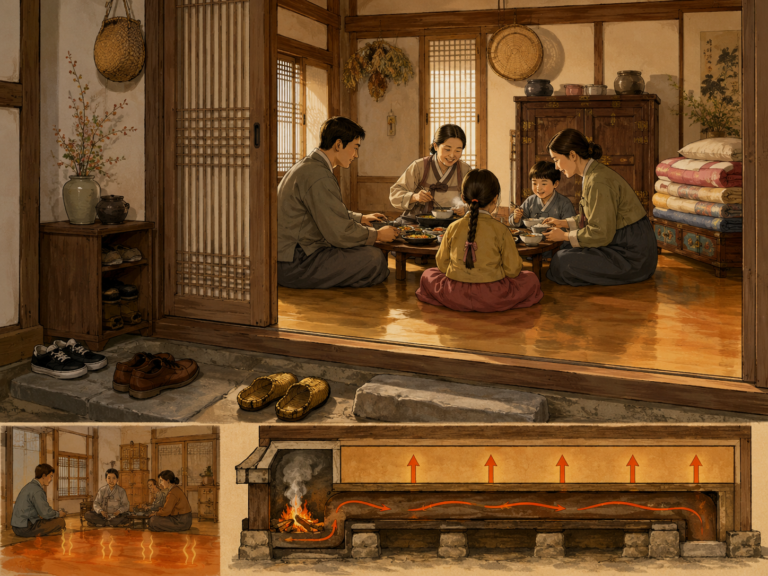
This history is reflected in one of the most common Korean greetings: “Did you eat?”
Today, it is usually just a warm way of asking, “How are you?” In harder times, however, it could be a genuine question. Had the children eaten? Was an elderly neighbor going hungry? Did someone need an extra bowl of rice?
Even when food was scarce, people tried to divide what they had so that no one nearby would be left without a meal. That instinct—to notice and care about another person’s condition—still survives in Korean culture.
It also means that when something unusual happens in public, people tend to notice.
“What’s going on?”, “Is that person all right?”, “Should someone call the police?”
People who appeared to be minding their own business a moment earlier can suddenly become witnesses, helpers, and very curious amateur detectives. The famous Korean tendency to pay attention to others can therefore become an uncomfortable surveillance system for anyone attempting a crime.
A Society Without Guns in Everyday Life
Another major reason Korea feels safe is its strict control of firearms.
Private firearm possession and public carry are heavily restricted. Even guns legally authorized for purposes such as hunting or sport shooting are generally kept under police supervision rather than stored casually at home.
As a result, most Koreans rarely—if ever—see a real gun in everyday life. Many Korean women may go their entire lives without seeing one outside a museum, military facility, or television screen.
When people enter a crowded subway, concert hall, or shopping center, they do not normally wonder whether someone nearby might be carrying a firearm. Gun violence is something most Koreans associate with movies and overseas news, not with an ordinary trip to the supermarket.
There is, however, an interesting contrast.
Although civilians cannot freely carry guns, a large proportion of Korean men have received military training because of mandatory national service. Most able-bodied men serve for more than a year, learning firearm safety, basic weapons handling, emergency procedures, guard duty, discipline, and fundamental combat skills.
After completing active service, they remain part of the reserve forces for several years and attend periodic training.
This does not mean that every Korean man is secretly an action hero. Military service does not turn an ordinary office worker into a martial arts master. Still, the quiet man eating kimbap at the bus stop—or the middle-aged father walking home with groceries—may have military training and experience responding to emergencies.
From a criminal’s perspective, that is not a particularly comforting thought.
When Someone Shouts for Help
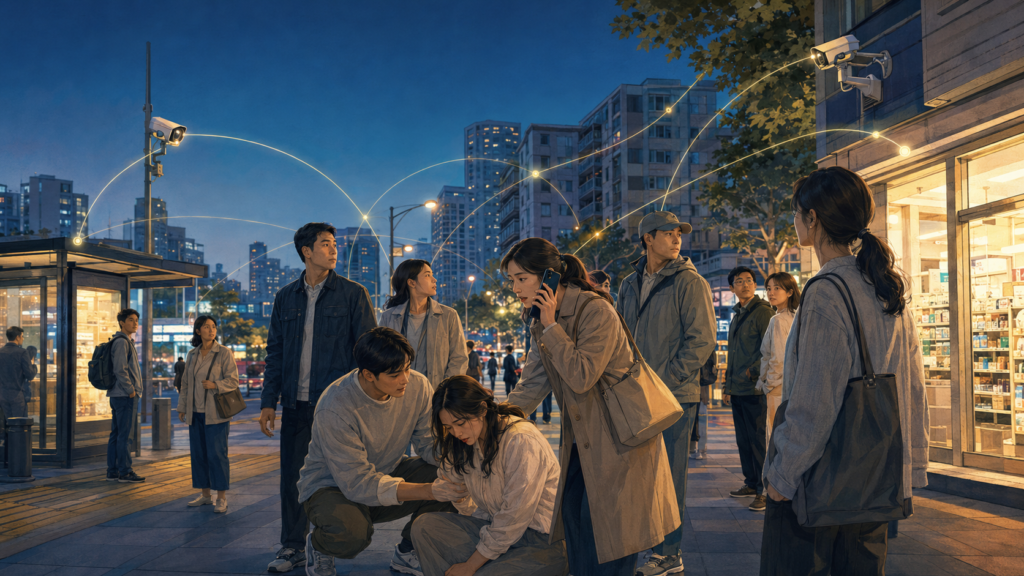
Imagine that someone is being assaulted or robbed on a busy Korean street and cries out for help.
One person may immediately call 112, Korea’s police emergency number. Another may help the victim move to a safer place. Someone else may remember the suspect’s clothing, face, or direction of escape. Several phones may begin recording at once.
If only two or three people clearly witness what happened, the offender is already in serious trouble.
There are now multiple witnesses. A police report has been made. The suspect’s appearance and movements may have been recorded. If the situation becomes urgent, bystanders may also work together to protect the victim.
This does not mean people should recklessly confront someone carrying a knife or another weapon. Keeping a safe distance and contacting the police should always come first. Real emergencies are dangerous, and no one should attempt a dramatic movie-style takedown.
The important point is that committing a crime in a Korean public space can quickly become difficult. Once people notice what is happening, the victim is no longer facing the situation alone.
For the offender, it can feel like being a rat trapped in a jar: watched from every direction, with very few ways out.
If the Witnesses Miss You, the Cameras Probably Won’t
Then there are the CCTV cameras.
Korean cities have dense networks of security cameras covering streets, alleys, subway stations, buses, parking lots, apartment entrances, and commercial areas. As one might expect from a country famous for its digital infrastructure, the quality and coverage of these systems continue to improve.
When a crime occurs, investigators can often combine footage from several cameras to reconstruct a suspect’s movements.
A person may avoid the camera at one intersection, only to appear on a convenience store camera. After avoiding that camera, they may be recorded on a bus. If they leave the bus, another camera may be waiting at the subway entrance.
Disappearing completely in a modern Korean city is much harder than it looks.
When CCTV footage is combined with witness accounts, phone recordings, transportation records, and reports from the public, the investigative net becomes even tighter.
Safety Built on Connection
There is no single explanation for South Korea’s relative safety.
Strict firearm controls, accessible emergency services, widespread military experience, dense CCTV coverage, and modern urban infrastructure all play a role. But underneath these systems is something more human: an interest in the well-being of other people.
“Did you eat?”
“Did you get home safely?”
“Does that person need help?”
These questions can occasionally sound intrusive. Yet they can also be the first step toward noticing that someone is in danger.
Korean public safety is not created by the police and cameras alone. It is also created by ordinary people who pay attention, recognize when something is wrong, and respond when another person asks for help.
Perhaps that is why committing a crime in Korea can be particularly difficult.
Guns are hard to obtain. Bystanders notice more than expected. The ordinary-looking man across the street may have military training. A camera may be watching from the next corner.
Most importantly, the moment someone shouts, “Help me!” the situation no longer belongs to that person alone.