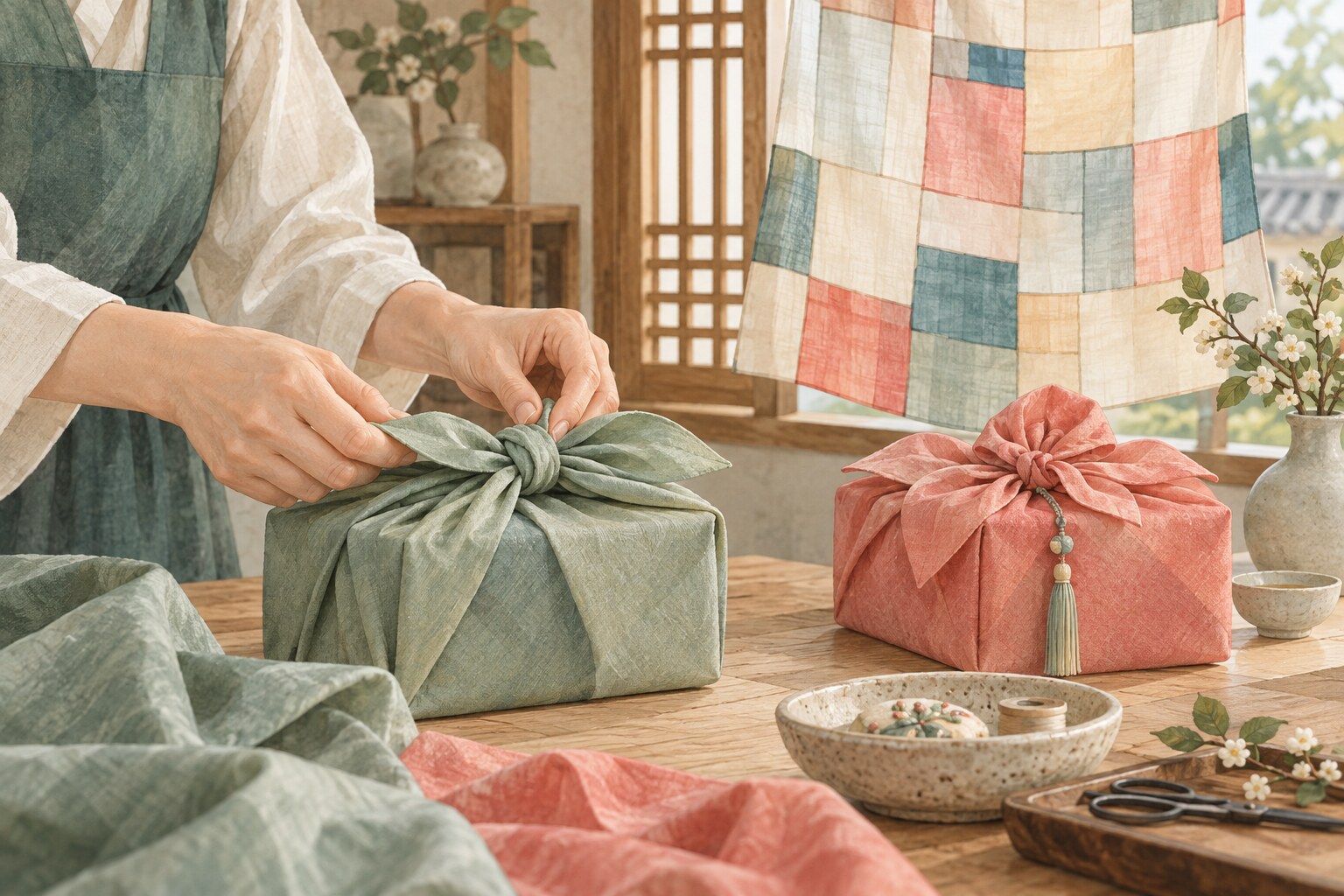
What is bojagi? Bojagi (보자기) is Korean wrapping cloth: a piece of fabric that can enclose, cover, or carry something. You may encounter it around a gift box, in a craft shop, or displayed as textile art. Its appeal lies partly in how a flat piece of cloth becomes a useful three-dimensional form.
Bojagi and jogakbo are related words
Bojagi is the broader term. Jogakbo (조각보) refers to patchwork cloth assembled from smaller pieces. A solid-colored wrapping cloth can be bojagi without being jogakbo. The distinction is helpful when shopping because not every patterned textile is made from separately joined pieces.
The Metropolitan Museum of Art, for example, identifies a Korean silk work from around 1950–1980 as a patchwork wrapping cloth, or jogakbo. It shows why these objects can be appreciated as carefully constructed textiles as well as practical wrappers. One museum object does not, however, represent every material or style.
Look closely at the construction
Start with the fabric. Is it sheer or opaque, soft or crisp, slippery or easy to grip? Then examine the edges and, for patchwork, the seams. These details affect how the cloth folds, how bulky a knot becomes, and how suitable it is for the object you want to wrap.
A printed patchwork pattern and actual sewn patchwork may look similar from a distance. Ask about the construction if that distinction matters to you. Neither is automatically the right choice for every purpose; what matters is knowing what you are buying.
Do not assume that every bojagi is antique, handmade, silk, or produced in Korea. A contemporary cloth may be beautiful and useful without any of those descriptions. Request the maker’s information when origin or technique is part of your reason for purchasing.
Choose a first cloth for an ordinary object
Begin with a small, lightweight box rather than a bottle or fragile item. The cloth needs enough room to cover the box and leave corners long enough to tie. Exact dimensions depend on both the object’s width and its height.
If shopping in person, ask for a demonstration with a similarly sized box. This reveals more than seeing the cloth laid flat. A fabric that looks generous on a table may leave very short ends once it wraps a deep container.
For a first experiment at home, a clean square cloth you already own can help you understand the folds before buying a special piece. Avoid treating a delicate decorative textile as a heavy-duty carrying bag.
A simple way to practice wrapping
- Lay the square cloth flat with one corner pointing toward you.
- Place the box near the center and check that the fabric reaches over it.
- Bring one corner over the box, then fold the opposite corner over it. Tuck loose fabric neatly without pulling hard.
- Bring the two remaining corners together above the box and tie a secure knot.
- Check that the object stays enclosed before moving it, and support the box from underneath.
This is a basic practice method, not the only Korean wrapping technique. If the corners barely meet, use a larger cloth. If the knot becomes excessively bulky, a thinner fabric or smaller box may work better.
Giving and receiving a wrapped gift
When you give a gift, say whether the cloth is included: “The wrapping cloth is part of the gift, too.” That small clarification prevents the recipient from wondering whether to return it.
If receiving one, untie it carefully instead of cutting through the knot. Ask about washing or ironing before cleaning an unfamiliar fabric. Follow the maker’s care instructions, especially for delicate fibers or mixed materials.
For gifts taken to a home, see our Korean housewarming guide. The occasion and the host’s preferences still matter more than elaborate packaging.
A reusable object you can keep using
Bojagi offers the possibility of wrapping again, but reuse depends on what you actually do with the cloth. Keep it somewhere accessible and use it for another suitable gift or small object. Its everyday usefulness can be as satisfying as its appearance.
Collection reference
The Metropolitan Museum of Art: Patchwork wrapping cloth (Jogakbo). The featured image is an original illustration, not a reproduction of the museum’s textile.