If you are invited into a Korean home, there is one rule you should remember immediately: Take off your shoes.
Walking into a Korean home while still wearing your outdoor shoes can feel extremely uncomfortable to the people who live there.
Why is this custom so deeply rooted in Korea?
The answer begins beneath your feet.
Korea’s Traditional Floor Heating: Ondol
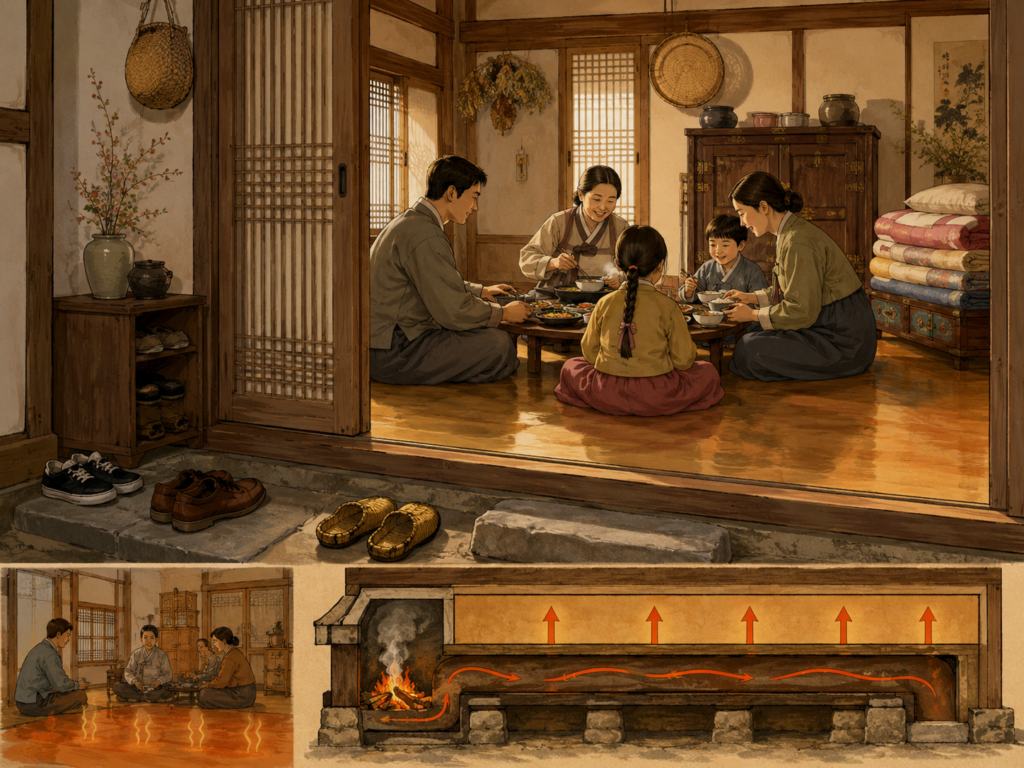
For centuries, Korean homes used a traditional heating system called ondol (온돌).
Instead of heating the room mainly through fireplaces or radiators, traditional ondol heated the floor from underneath.
As the floor became warm, people naturally began spending a great deal of their daily lives on it.
They sat on the floor.
They ate on the floor.
Children played on the floor.
And at night, people spread bedding directly on the floor and slept there.
The floor, therefore, was not simply something people walked across.
It functioned as a chair, dining area, playground, and bed.
Naturally, keeping it clean was extremely important.
Bringing dirt from the street into that living space with outdoor shoes would have made little sense.
The House Changed, but the Habit Remained
Modern Korean homes look very different from traditional houses.
Today, Koreans have sofas, dining tables, chairs, beds, and modern heating systems.
Yet floor heating is still extremely common, and the tradition of removing outdoor shoes remains firmly established.
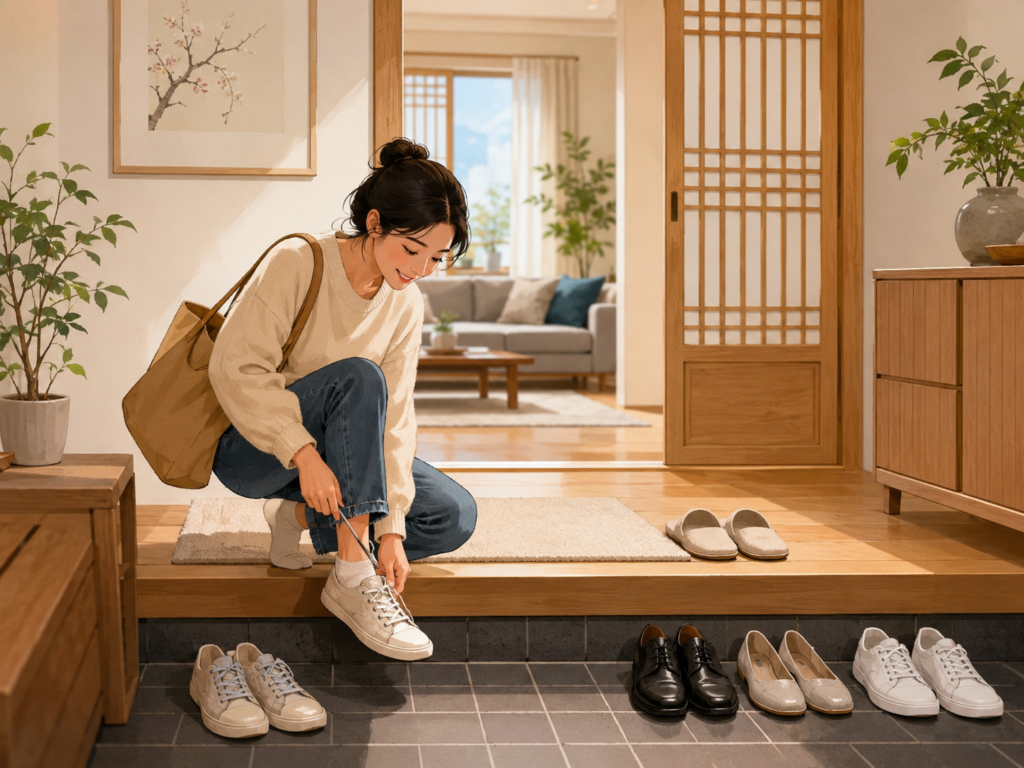
Most Korean homes have a small entrance area called a hyeongwan (현관).
You enter the home, remove your shoes there, and then step up into the clean interior.
The difference between the shoe area and the living area is very clear in the Korean mind.
One is connected to the outside world.
The other is part of the home.
Why Koreans React to Shoes on a Bed
This also explains something foreigners may find amusing.
In Western movies or TV shows, a character may enter a bedroom wearing shoes, lie down on the bed, and put their feet—still wearing those shoes—right on top of the blankets.
Many Koreans have an immediate reaction:
“Those shoes were just outside!”
For someone raised in a floor-centered culture, the idea can feel surprisingly uncomfortable.
Taking off shoes indoors is therefore not simply a matter of good manners.
It is the result of centuries of architecture, heating technology, cleanliness, and a way of living in which the floor itself became an important part of everyday life.
Once you understand ondol, the Korean no-shoes rule suddenly makes perfect sense.
Visiting a home: what to do at the entrance
Pause in the 현관 (entrance area) before stepping onto the indoor floor. Leave outdoor shoes on the shoe side of the boundary, then step into the room in socks or the slippers your host offers. Avoid putting your socked feet onto the outdoor-shoe area and then walking through the home. Place your shoes neatly to one side so the next person can enter.
Look for the actual boundary rather than expecting every home to have a large step. Apartment entrances and accessible homes can have different layouts. If you need to sit down to remove your shoes, ask your host for a chair or help.
Homes, restaurants, and accommodation are different
Do not remove your shoes automatically at every indoor doorway. Shops and many restaurants allow outdoor shoes. A shoe rack, a raised seating area, a sign, or the host’s instructions can tell you when removal is expected. At a guesthouse or hotel, check where indoor slippers should be used. If separate bathroom slippers are provided, leave them in the bathroom after use.
A short conversation at the door
Guest: 신발은 어디에 벗어요? — Where should I take off my shoes?
Host: 여기에서 벗으세요. — Please take them off here.
Guest: 슬리퍼 신어도 돼요? — May I wear the slippers?
Host: 네, 신으세요. — Yes, please do.
Learn the verbs with the action
신다 means to put on or wear footwear; 벗다 means to take it off. Learn 신발을 신어요 and 신발을 벗어요 as complete phrases. 신발을 벗어야 해요? asks “Do I need to take off my shoes?” Asking is useful when the entrance gives you no clear clue.
Try it: You arrive at a restaurant with a shoe rack but cannot tell which seating area you will use. Ask 신발을 벗어야 해요? and wait for the staff member’s answer before entering.
Keep learning with how to respond to “Have you eaten?” or choosing polite speech when meeting someone.