The First Thing to Buy in Korea After Your SIM Card
Once Your Phone Is Connected, Buy a Transportation Card
You have finally arrived in Korea.
After passing through immigration and collecting your luggage, your first task will probably be getting your phone connected. You buy a SIM card at the airport or activate an eSIM prepared before your flight.
Now you can use maps, contact your hotel, and translate Korean signs. It may feel as though you are ready to leave the airport.
But there is one more thing you should do first.
Before beginning your journey into Seoul, stop at an airport convenience store and buy a transportation card.
Your phone will show you where to go. Your transportation card will take you there.
Why You Need a Transportation Card in Seoul
Seoul has an extensive public transportation system that connects almost every part of the city.
The subway reaches central Seoul, Incheon, and many areas of Gyeonggi Province. Buses fill the gaps between subway stations and take passengers into neighborhoods, markets, university districts, and smaller streets.
The subway map may look overwhelming when you first see it. In practice, however, using the system is relatively simple. Search for your destination on a map app, follow the recommended line, and check the station number and exit.
Payment is the part that becomes much easier with a transportation card.
You can purchase a single-journey subway ticket each time you travel, but that ticket works only on the subway. It cannot be used when you transfer to a bus.
With one transportation card, you can use:
- Subways throughout Seoul and the metropolitan area
- Seoul city buses and neighborhood buses
- The AREX All-Stop Train from Incheon Airport
- Taxis that display the transportation-card symbol
- Public transportation in many other parts of Korea
A card also allows you to receive transfer discounts when changing between eligible buses and subway lines. It is more convenient than purchasing a separate ticket for every journey and is usually slightly cheaper than paying for individual rides.
A transportation card is therefore more than a payment method. It is the key that connects Seoul’s subway and bus networks.
What to Say at the Airport Convenience Store
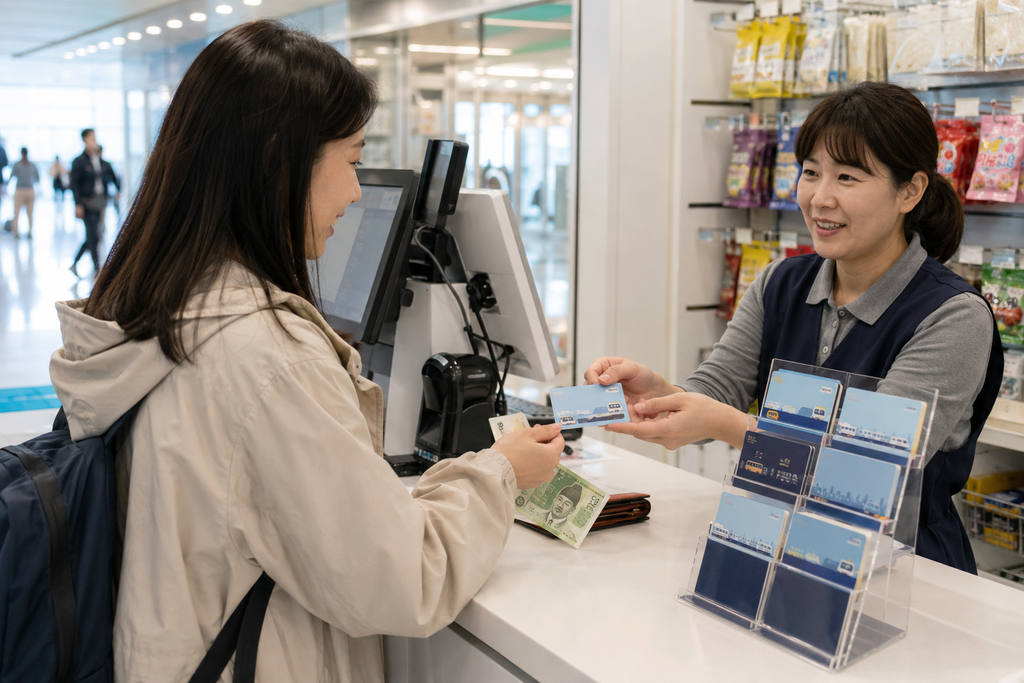
After connecting your phone, look for a convenience store in the airport’s public arrivals area. Transportation cards are commonly sold at convenience-store chains such as CU, GS25, and 7-ELEVEN.
The most widely recognized option is Tmoney.
You can say:
“티머니 카드 주세요.”
Tmoney kadeu juseyo.
“A Tmoney card, please.”
A standard card generally costs around 3,000–5,000 won, although character cards and special designs may cost more. The price of the card does not include transportation credit, so buying the card is only the first step.
You must also load money onto it.
Try saying:
“3만 원 충전해 주세요.”
Samman won chungjeonhae juseyo.
“Please add 30,000 won.”
For a short stay in Seoul, loading approximately 20,000–30,000 won is a practical starting point. If the balance becomes low, you can recharge the card at convenience stores or subway-station machines.
Keep some Korean won available for recharging, and check the payment methods shown by the particular machine or retailer. Do not assume that a foreign bank card can reload every type of transportation card.
Using Your Card on the Airport Railroad
Many visitors take the AREX Airport Railroad from Incheon Airport to Seoul.
AREX operates two different services.
The Express Train travels directly to Seoul Station and has reserved seating. The All-Stop Train stops at stations including Hongik University and Digital Media City.
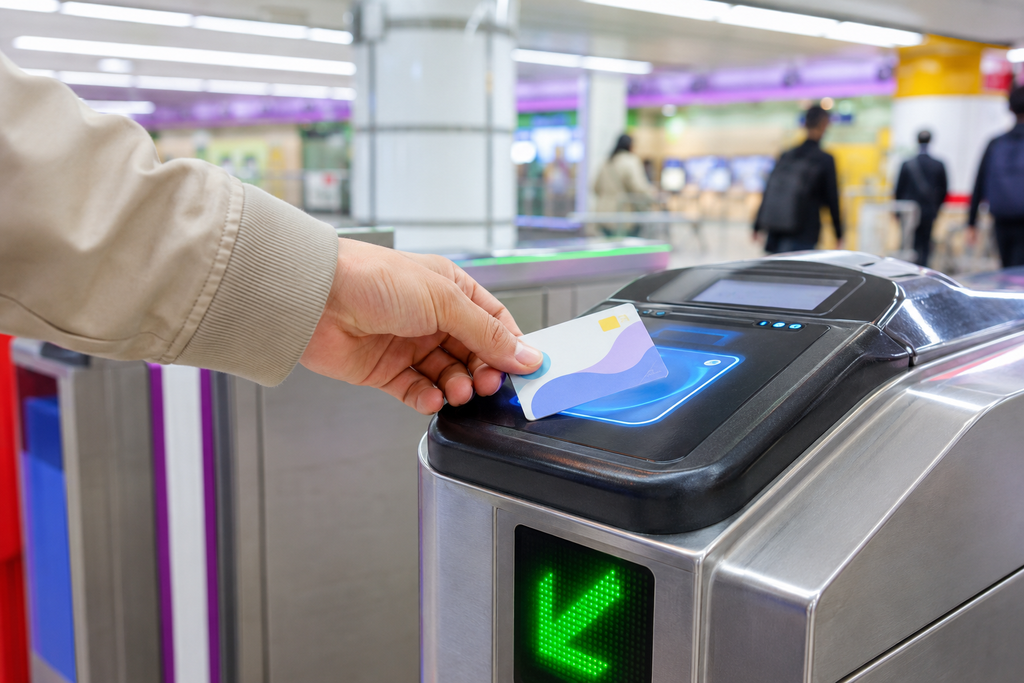
You can use a Tmoney card on the All-Stop Train. Simply tap the card at the entrance gate and tap again when leaving at your destination.
The Express Train requires a separate ticket. Buying a Tmoney card does not allow you to enter the Express Train directly.
If you are staying near Hongdae or plan to transfer to another subway line, the All-Stop Train and a Tmoney card can be a particularly convenient combination.
Tap In and Tap Out on the Subway
Using a transportation card on the Seoul subway is simple.
Tap the card on the reader when entering the station. At your destination, tap it again when leaving. The system calculates the fare according to the distance traveled.
The gate display shows the fare deducted and the remaining balance. Check it occasionally so that you do not discover an empty card when you are in a hurry.
If you need more credit, multilingual recharge machines are available in subway stations.
Tap When Getting On—and When Getting Off—the Bus
One of the most common mistakes made by first-time visitors is forgetting to tap the card when leaving a bus.
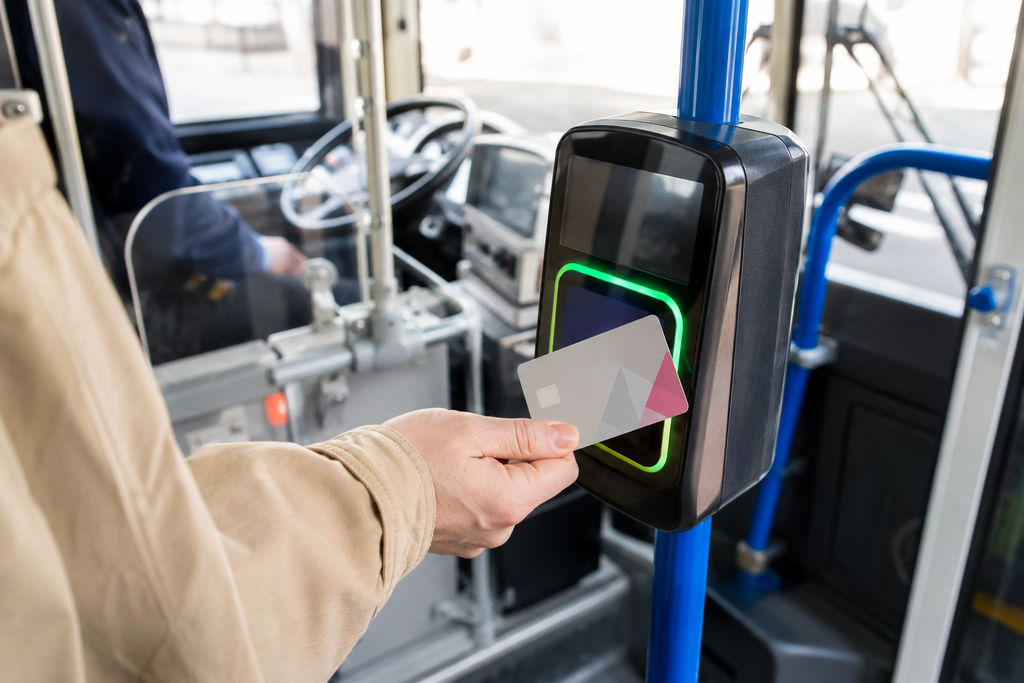
Enter through the front door and tap your card on the reader. Before reaching your stop, press one of the stop buttons. When leaving through the rear door, tap the card on the exit reader.
Even if you are not transferring immediately, it is a good habit to tap when getting off. The system needs your exit point to calculate distance-based fares and eligible transfers correctly.
The rule is easy to remember:
Subway: tap when entering and leaving.
Bus: tap when boarding and getting off.
Transfers Are the Real Advantage
The best feature of Seoul’s transportation system is that buses and subways function as one connected network.
For example, you can take the subway and then transfer to a bus for the final part of your journey. Instead of paying an entirely new base fare for each ride, the system calculates the total fare according to the distance traveled and applicable transfer rules.
To receive the transfer benefit, use the same card throughout the journey and remember to tap when leaving the bus. Transfers must also be made within the permitted time, so follow your route without making a long stop between rides.
Once you understand this system, traveling across Seoul becomes remarkably easy.
Keep the Card Until the End of Your Trip
Tmoney is useful beyond public transportation. You can also use the card’s balance at participating convenience stores and certain other retailers.
The card itself can be used again on a future trip to Korea. If you select a design you like, it can also become a small souvenir.
Remember that the original purchase price of the card is separate from its balance and is generally nonrefundable. Refund conditions and service charges for the remaining balance vary, so using a small leftover balance at a participating convenience store near the end of your trip may be the simplest option.
Two Things to Do Before Leaving the Airport
When you arrive in Korea, connect your phone first. A SIM card or eSIM gives you access to maps, translation tools, and messages.
Then, before leaving the airport, visit a convenience store, buy a Tmoney card, and load money onto it.
With those two things prepared, exploring Seoul becomes much easier.
Your phone tells you where to go.
Your transportation card takes you there.
The order is simple:
First, connect your phone.
Second, buy and recharge a transportation card.
Third, begin your journey into Seoul.
Korean phrases when you need help
충전은 어디에서 해요? — Where can I recharge it?
잔액이 얼마예요? — How much balance is left?
카드가 안 돼요. — The card is not working.
다시 찍어도 돼요? — May I tap it again?
In this context, 찍다 means to tap or scan the card. It does not mean inserting the card into a slot. If a reader gives an error, ask staff before repeatedly tapping, and show the card or the message so they can understand the problem.
A short practice conversation
Traveler: 티머니 카드 주세요. — A Tmoney card, please.
Traveler: 만 원 충전해 주세요. — Please add 10,000 won.
Traveler: 잔액이 얼마예요? — How much balance is left?
Practice changing only the amount: 만 원 (10,000 won), 이만 원 (20,000 won), 삼만 원 (30,000 won). The amount you request is the credit to load, separate from the purchase price of a new card.
Official information
For card types, purchase locations, and refund guidance, consult the Korea Tourism Organization’s VISITKOREA transportation card guide. The guide lists standard Tmoney cards at approximately 3,000–5,000 won. Card products, prices, and payment options may change; check the relevant operator before travel. Source checked September 12, 2026.