You have found a Korean restaurant, and the food in the window looks inviting. Then you open the door. Someone asks a question, the menu has unfamiliar numbers, and there is a small button on the table. What should you do first?
You do not need a long speech to manage this moment. A few short expressions can help you ask for a seat, order what you want, and check anything you do not understand. Restaurant arrangements vary, so treat the phrases below as tools for asking rather than rules that every business follows.
At the door: how many people?
A staff member may greet you with 몇 분이세요? — “How many people are in your party?” Here, 분 is a respectful counter for people. In this setting, the question is about your group size, not your age or how many minutes you need.
한 명이에요. — One person.
두 명이에요. — Two people.
세 명이에요. — Three people.
If you see an empty table but are unsure whether it is available, ask 여기 앉아도 돼요? — “May we sit here?” It may be reserved or waiting to be cleared. A quick question is easier than moving all your belongings after you sit down.
Before ordering: what does 2인분 mean?
인분 indicates servings. A menu that says 2인분부터 주문 가능 means that the item can be ordered starting from two servings. This can appear for dishes prepared for sharing. It does not necessarily mean every dish in the restaurant has the same minimum.
If you are eating alone, point to the dish and ask 이거 일 인분도 주문할 수 있어요? — “Can I order one serving of this?” If the answer is no, ask 혼자 먹을 수 있는 메뉴가 있어요? — “Is there a menu option for one person?”
Do not assume that a large-looking dish is priced for the whole table. Check whether the displayed amount is per serving or per dish before ordering.
The most useful pattern: this, please
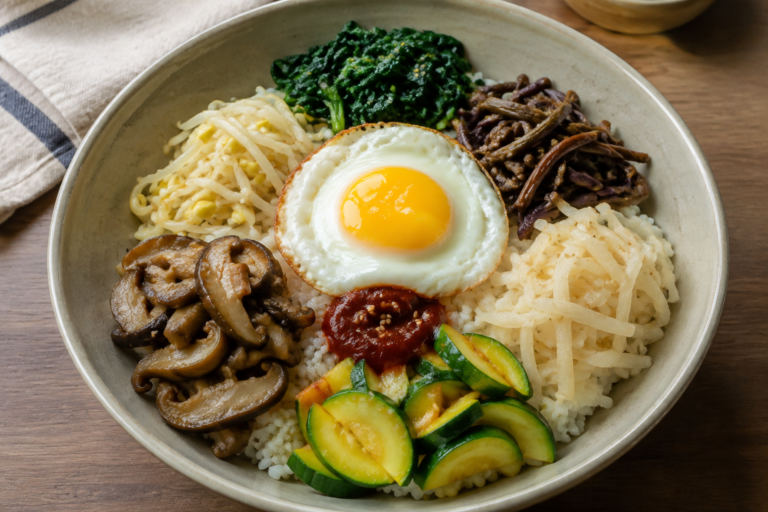
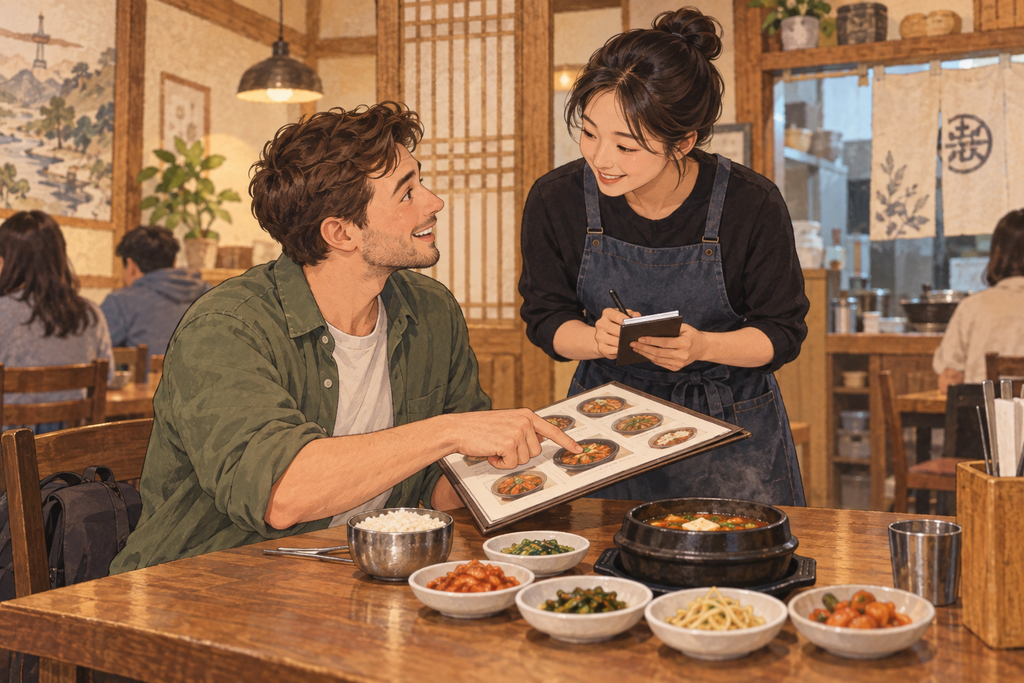
Pointing to an item and saying 이거 하나 주세요 — “One of these, please” — is a practical beginning. When the name is familiar, use it: 비빔밥 하나 주세요 — “One bibimbap, please.” For two, say 비빔밥 두 개 주세요.
주세요 turns a noun into a polite request. You can reuse it throughout the meal: 물 주세요 (Water, please), 메뉴판 주세요 (A menu, please), and 숟가락 하나 주세요 (One spoon, please).
Some restaurants use a kiosk or a tablet instead of taking orders at the table. If you cannot find how to begin, ask 주문은 어디에서 해요? — “Where do I order?” Showing the screen and saying 도와주세요 — “Please help me” — is also useful.
Calling a staff member without shouting
If there is a clearly marked service bell on the table, you can use it to request assistance. Press it once and give the staff time to respond. If there is no bell, make eye contact and say 저기요 — “Excuse me.”
저기요 is a way to get someone’s attention. Follow it with your request: 저기요, 물 좀 주세요 — “Excuse me, could we have some water?” In requests, 좀 often softens the wording; it does not always mean that you want only a tiny amount.
Water, utensils, and side dishes
Look for signs such as 물은 셀프입니다 — “Water is self-service.” The cups or water dispenser may be in a shared area. Utensils may be in a table container or a drawer. If you cannot find them, ask 수저는 어디에 있어요? — “Where are the utensils?”
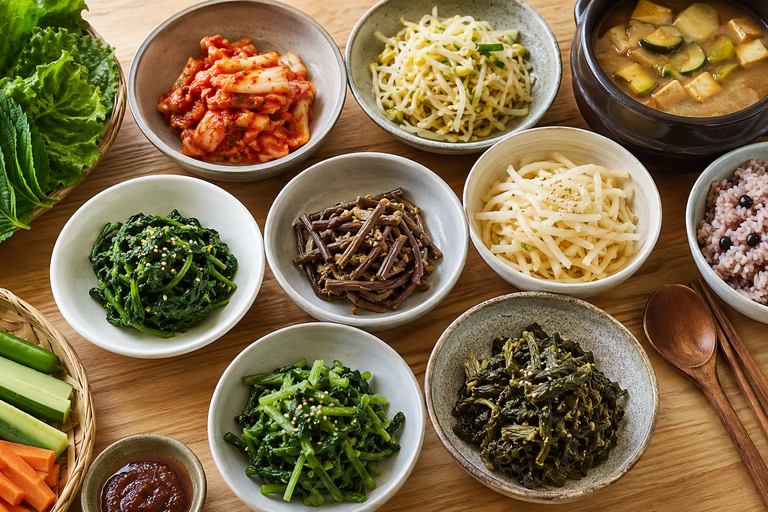
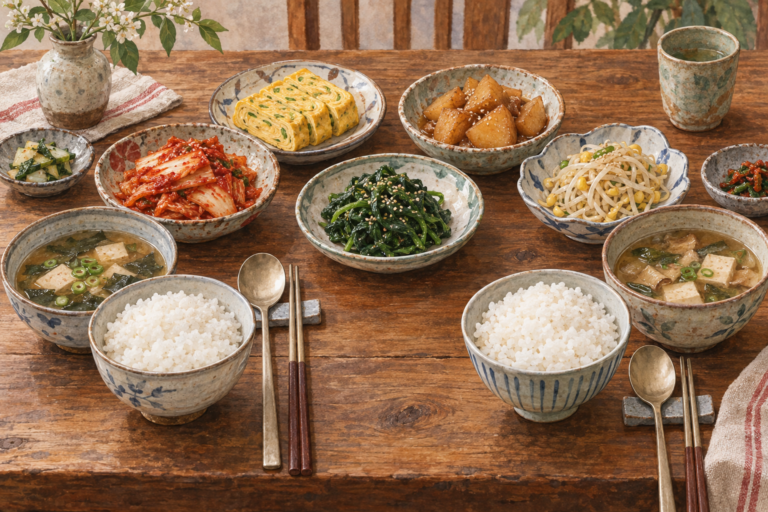
Small side dishes are called 반찬. If you would like more, ask 이 반찬 조금 더 주실 수 있어요? — “Could we have a little more of this side dish?” Some restaurants offer refills for certain side dishes, but availability and charges depend on the item and the restaurant.
When unsure, ask 추가하면 돈을 더 내야 해요? — “Is there an extra charge if we add more?” Order only what you expect to eat. A refill is not a reason to leave a large amount untouched.
Spicy food: ask before the order is prepared
이거 많이 매워요? means “Is this very spicy?” If you would prefer less heat, try 덜 맵게 해 주실 수 있어요? — “Could you make it less spicy?” For a sauce served separately, ask 소스는 따로 주세요 — “Please put the sauce on the side.”
These are requests, not guarantees. A dish made with a prepared sauce or broth may be difficult to change. Ask before ordering so you can choose something else if necessary.
Paying and saying goodbye
Some restaurants take payment at the counter after the meal; others use payment before eating or at the table. Ask 계산은 어디에서 해요? — “Where do I pay?” To ask about separate payments, say 따로 계산할 수 있어요? — “Can we pay separately?” Confirm the available arrangement before handing over several cards.
As you leave, 잘 먹었습니다 is a natural way to thank the people who prepared or served your meal. It literally means that you ate well, but in this setting it conveys appreciation: “Thank you for the meal.”
A short conversation to practice
Staff: 몇 분이세요? — How many people?
Customer: 두 명이에요. 여기 앉아도 돼요? — Two. May we sit here?
Staff: 네, 앉으세요. — Yes, please sit down.
Customer: 비빔밥 두 개 주세요. — Two bibimbaps, please.
Customer: 물은 셀프예요? — Is water self-service?
Later: 계산은 어디에서 해요? — Where do I pay?
On leaving: 잘 먹었습니다. — Thank you for the meal.
This is a constructed practice conversation. Try changing 두 명 to 한 명 and ordering only one bibimbap. Your new lines are 한 명이에요 and 비빔밥 하나 주세요.
The goal of your first restaurant visit is not perfect Korean. It is a clear request and a shared understanding. Begin with one expression, listen to the answer, and ask again when something is unclear.
Keep learning
Read what makes bibimbap more than rice with vegetables, practice responding to “Have you eaten?”, or open the beginner Korean study guide.
For meanings and pronunciation, look up 주세요, 인분, 반찬, and 계산 in the National Institute of Korean Language’s Korean–English Learners’ Dictionary.