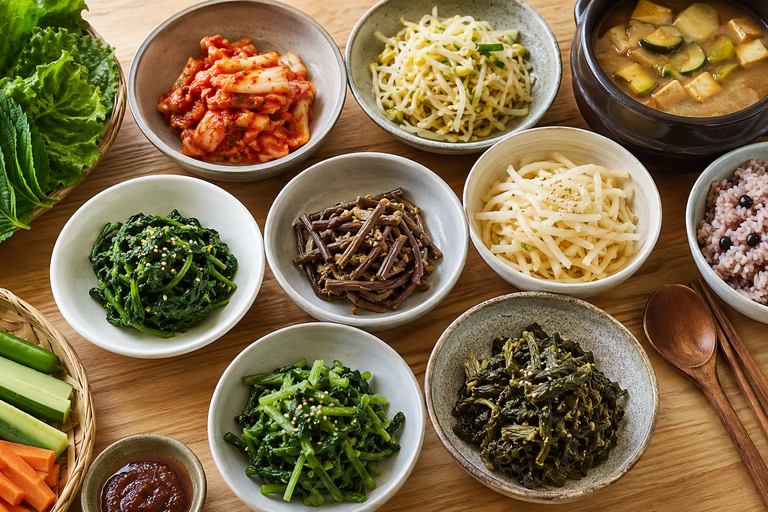
You order one main dish, but several small plates arrive before it. There may be kimchi, seasoned vegetables, potatoes, or a rolled omelette. If you are wondering “What is banchan?”, these little dishes are the answer: 반찬 are side dishes eaten alongside a Korean meal.
They are part of the meal’s variety, not necessarily a separate appetizer course. Rice, soup, a main dish, and small shared plates can be on the table together.
Why so many small dishes?
Think of the table as a set of combinations. A mouthful of plain rice can be followed by something salty, sour, mild, crisp, or soft. You can move between flavors instead of finishing one course before the next begins.
There is no single collection that every restaurant must serve. The selection depends on the establishment, the meal, ingredient availability, and the cook. A simple neighborhood lunch and a larger set meal may look very different.
A modest selection is not automatically a sign of poor quality. A few carefully prepared sides can suit a meal better than many dishes you do not want to eat.
Five names you may recognize
Kimchi (김치) is a broad family of seasoned, fermented vegetable preparations. Cabbage kimchi is familiar, but other vegetables and styles exist.
Namul (나물) refers to a range of prepared vegetable dishes. Spinach and bean sprouts are common examples. Seasoning and cooking methods vary, so “namul” does not identify one fixed recipe.
Gamja-jorim (감자조림) is braised potato. Its seasoning may be sweet and savory, with a texture that depends on the cook’s method.
Gyeran-mari (계란말이) is rolled omelette, often sliced into bite-sized pieces. It may include vegetables or other fillings.
Eomuk-bokkeum (어묵볶음) is stir-fried fish cake. Its name is useful to recognize because it may look like an unfamiliar vegetable or strip of tofu to a first-time visitor.
These are examples, not a checklist of what you should receive.
How do you eat the shared dishes?
Take a small amount at a time and eat it with your rice or the rest of the meal. You do not have to mix every side into the rice bowl. If the table has serving utensils, use them to transfer food to your own plate.
Start with a little of an unfamiliar dish. This lets you find out what you enjoy without taking more than you want. A red dish is not a precise measure of heat, and a pale dish is not a guarantee of mild seasoning.
If a plate is difficult to reach, ask someone to pass it instead of reaching across another person’s bowl.
Are banchan and refills free?
At many everyday restaurants, the initial small sides come with the ordered meal, and some basic sides can be refilled without a separate charge. However, you should not assume that every dish or every additional portion is included.
An item sold separately on the menu may look similar to a complimentary side. Special dishes, additional egg dishes, or larger portions can have their own prices. Ask “이 반찬은 더 받을 수 있어요?” — “Could we have more of this side dish?” If the cost is unclear, follow with “추가 요금이 있어요?” — “Is there an extra charge?”
At a self-service station, follow the signs and take a small amount first. You can return for more if allowed.
Ingredients are not always visible
A vegetable side may contain fish sauce, fermented seafood, meat stock, or other ingredients you cannot identify by looking. For a dietary restriction, name the ingredient you need to avoid and ask staff to check. “It looks vegetarian” is not enough information.
If accurate ingredient confirmation matters, choose food for which the restaurant can explain the preparation. Do not rely on a generic list of dish names as a guarantee.
For the broader table tradition, see Korea.net’s introduction to Korean food and banchan. Our first Korean restaurant visit guide covers ordering, while kimjang culture explores making and sharing kimchi.
Menus, recipes, and refill policies differ. Ask the restaurant about the meal in front of you.