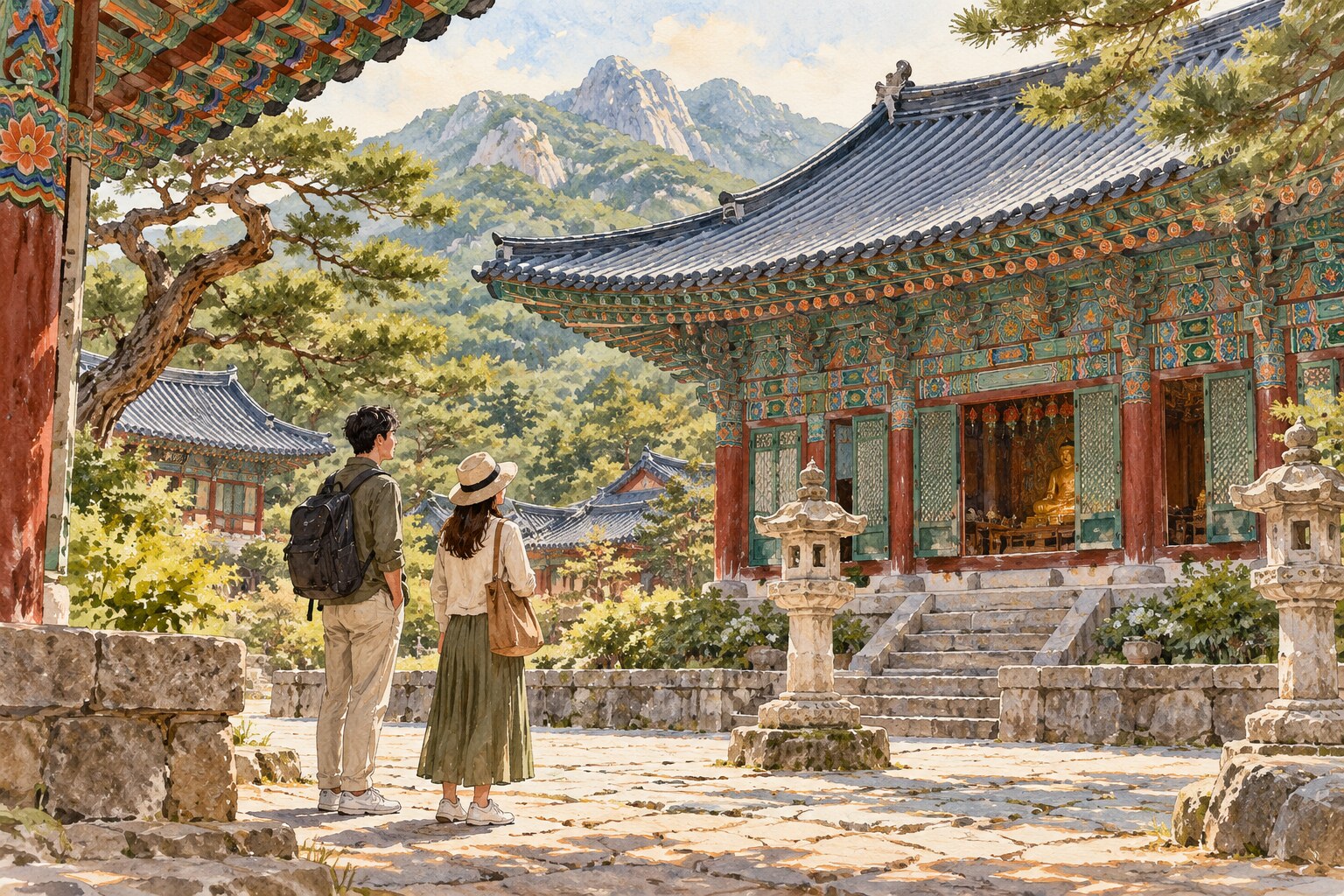
Korean temple etiquette begins with a simple observation: the place you are visiting may also be someone’s place of prayer, work and daily life. You can appreciate a courtyard, painted roof brackets or a mountain setting without knowing every ritual. Give worshippers room, read the signs, and ask before entering a space you do not understand.
Start in the public courtyard
After entering the visitor area, take a moment to notice how people move through it. Which buildings are open? Where are people praying? Are there ropes, closed gates or signs marking resident areas? An open-looking doorway is not necessarily an invitation to explore.
Keep conversations low and silence notification sounds. If you need to make a call, step away from prayer halls and other quiet spaces. Avoid playing music or recording a spoken travel video beside a ceremony. The official Templestay etiquette guidance emphasizes quiet behavior and consideration for people who are praying.
Before entering a prayer hall
Check whether visitors may enter at that time. Follow the designated entrance; official Templestay guidance describes using side doors and leaving the central area clear. Local signs and a staff member’s directions are the best guide for that particular hall.
Look for the shoe-removal area and follow the instructions there. Place shoes neatly without obstructing the entrance. Once inside, avoid walking between a worshipper and the focus of their prayer. Move slowly, keep a bag close to you, and choose a position that leaves space for others.
You do not need to improvise a ritual for a photograph. If a guide invites visitors to learn a bow, listen to the explanation and ask if you are unsure. If you prefer to observe, ask where you can do so respectfully.
Dress for the setting and the movement
Choose comfortable, modest clothing that makes sitting, bending or walking easy. Shoes that are simple to remove are useful if you enter a hall. A visit involving outdoor steps may call for different footwear from a short stop on a city street.
For an organized program, read its clothing requirements before arrival. Do not assume that all temples supply uniforms or that one program’s instructions apply everywhere. If kneeling, floor seating or stairs would be difficult, ask about alternatives in advance.
Ask about photographs before raising the camera
A courtyard photograph and a close-up of someone praying are different requests. Check posted photography rules, particularly at hall entrances. Ask permission before photographing identifiable worshippers or monks. If someone declines, put the camera away without arguing.
Leave doorways and walking routes clear while framing a picture. Do not touch bells, drums, altar objects or lanterns to improve a composition. When a ceremony is underway, being an unobtrusive observer matters more than getting a particular image.
A useful question is 사진 찍어도 돼요? — “May I take a photo?” Point gently toward the area or object you mean so the answer is about that specific photograph.
A day visit and Templestay are different plans
Templestay offers organized opportunities to experience Buddhist culture and temple life. It is not simply a name for any overnight room near a temple. Activities, participation expectations, language support and sleeping arrangements depend on the program.
Before booking, check arrival time, the schedule, meals, bathroom arrangements and what participation involves. Ask whether instructions are available in a language you understand. Do not assume that you can arrive late, skip scheduled activities or leave and return as you would at a hotel.
Plan a comfortable exit as well as an arrival
If the temple is outside a city center, check your return transport before you begin exploring. Leave enough time to walk back without rushing through the grounds. Carry away your rubbish and keep food to areas where it is permitted.
For visits that include an outdoor trail, our first hiking guide for Korea covers a different part of the day: choosing and preparing for the walk. Temple etiquette concerns the shared religious space you enter along the way.
Sources: Official Templestay FAQs and etiquette (Korean); Templestay program information (English). Follow the individual temple’s posted rules.