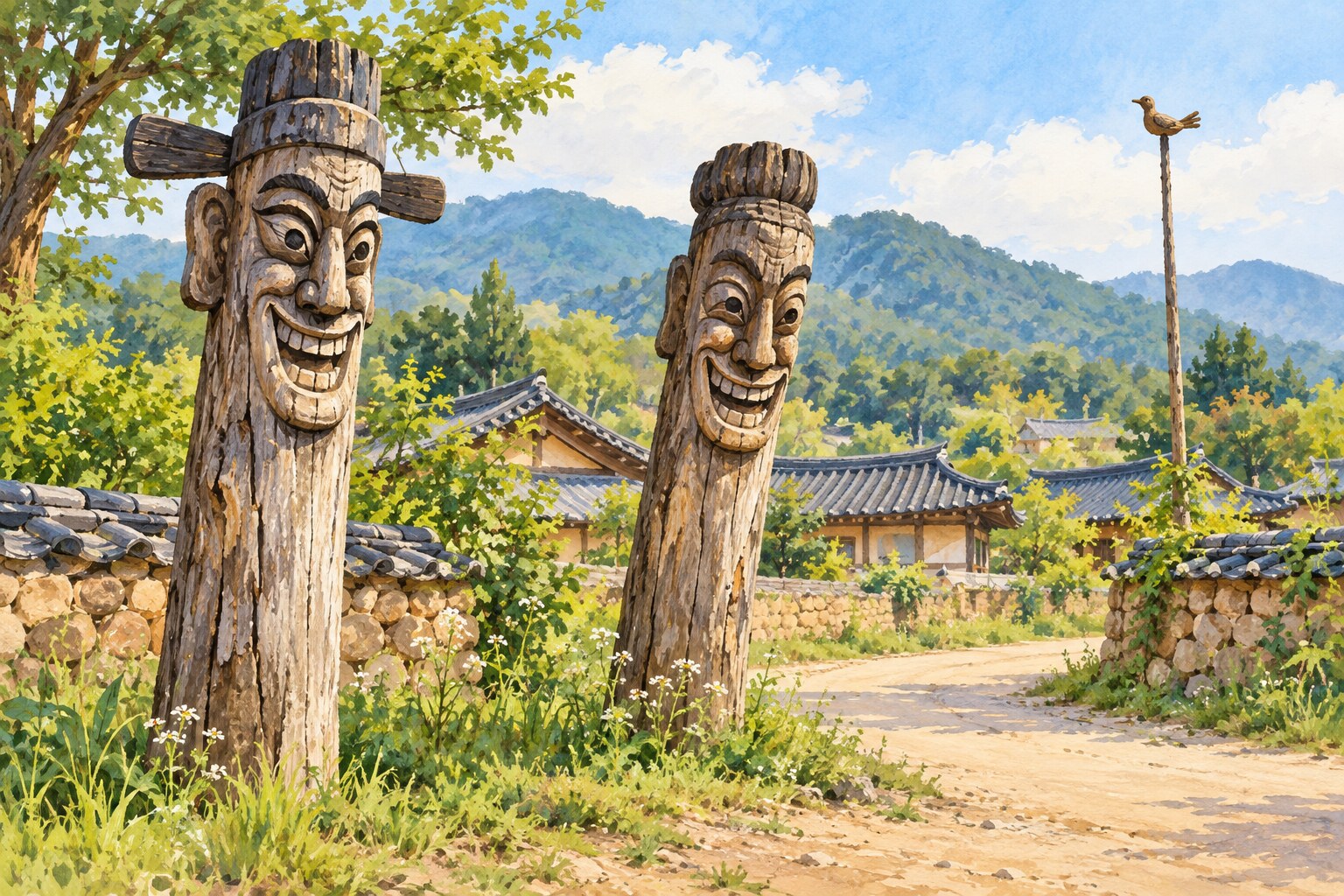
Wide eyes, an enormous nose, exposed teeth: a jangseung (장승) can look fierce and funny at the same time. If you meet one at a village entrance or in a museum, the face naturally draws your attention. The more interesting question is why someone wanted that face to stand there.
A guardian at the edge of a community
The National Folk Museum of Korea describes jangseung as human-shaped figures made from wood or stone, placed at locations such as village entrances, temple approaches and passes. In folk belief, they could serve as guardians. Their role belongs to the place and community around them, rather than to a single universal story.
In its exhibition account of village beliefs, the museum explains the wish to keep harmful forces, illness and misfortune away from the settlement. Read this as an account of traditional belief, not as a claim about what a sculpture can physically do.
Why the face deserves a second look
A quick photograph may turn the figure into a comic character. Instead, give yourself time to observe how the face was formed. Are the features cut deeply or suggested with just a few lines? Does the trunk’s shape become part of the head? Does the expression change when you look from the side?
There is no need to decide immediately whether it is smiling or threatening. That uncertainty can make the encounter memorable. It also gives you a better question for a guide than simply asking whether the post is “good luck.”
A museum story with a surprising condition
The museum’s account of the Ssanggyesa jangseung explains that the guardians were collected for the Korean Folklore Museum in 1966. Moving them was not simply a matter of picking up two objects. Replacements were arranged so that their original location would not be left without guardians.
That detail changes the way a museum object can be understood. A transfer into a collection was also a negotiation about what should remain in a meaningful place. The account offers a specific local history; it should not be treated as the biography of every jangseung you encounter.
And what is the bird on the tall pole?
A nearby sotdae (솟대) may be easier to recognize by the bird figure perched high above the ground. The National Folk Museum treats sotdae as sacred poles within village belief and associates the bird with wishes for abundance and fertility.
Jangseung and sotdae are related parts of this cultural landscape, but they are not two names for the same object. Noticing the difference gives you a useful starting vocabulary: a human-like guardian figure, and a bird-topped pole.
How to approach them as a visitor
- Read the local label before assuming the object is old, original or still used in ritual.
- Photograph from the public path without climbing, leaning against or hanging items on the figure.
- If a community ceremony is taking place, ask where visitors may stand and whether photography is welcome.
- Ask about the particular place: “Why was this guardian installed here?”
You do not need to share a belief to respect the people connected with it. The same principle helps when visiting religious spaces; our Korean temple etiquette guide covers that setting in more detail. With jangseung, keep your attention on the local story behind the face.
Sources: National Folk Museum of Korea, The Mysterious Village exhibition archive and the Ssanggyesa guardian posts (Korean). The cited exhibition is historical, not a current event listing. Featured image: original AI-generated illustration, not the Ssanggyesa objects.