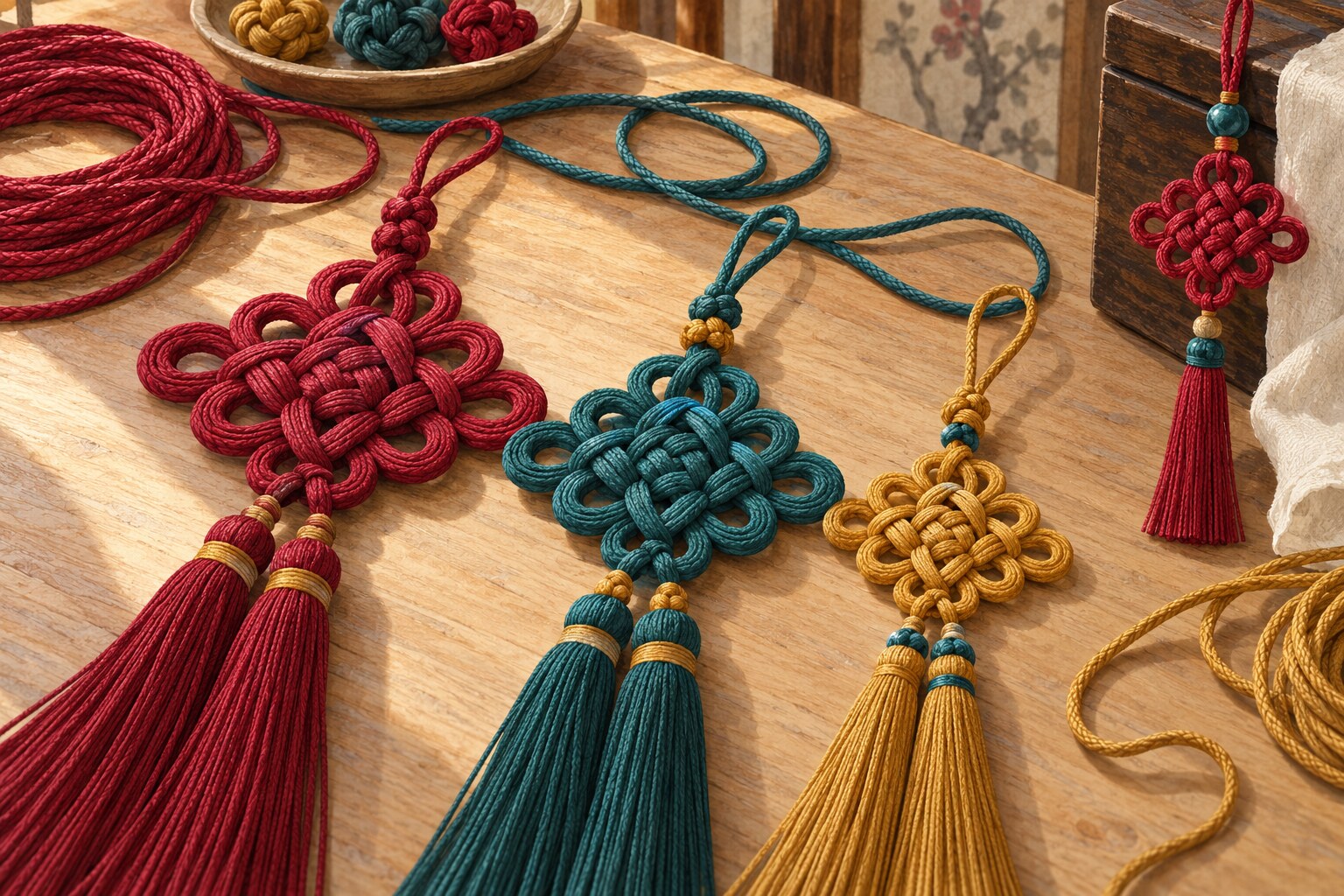
A small ornament hanging from traditional clothing may catch your eye through its color or tassel. Look above the loose threads and you may find the most intricate part: the knot. Korean maedeup (매듭) turns cord into a carefully arranged form, giving a modest object a surprising amount of structure.
Two kinds of making are involved
The National Folk Museum of Korea explains that decorative maedeup is formed by knotting and tightening plaited cord. That cord, known as dahoe or kkeunmok, is itself made from threads. Making the cord and shaping it into a knot are related but distinct tasks.
This is a useful distinction for a visitor. The color is only the beginning. The cord’s thickness, the arrangement of loops and the way the form has been tightened all contribute to what you see. A knot can look compact while containing a path that is difficult to follow with your eyes.
Maedeup is not simply another word for tassel
Try separating an ornament into its visible parts: the suspension loop, the knotted section, any central pendant and the tassel. The complete object may combine several crafts. A norigae (노리개), a traditional decorative pendant associated with clothing, can incorporate maedeup, but the whole ornament and the knot are not identical terms.
That distinction also helps when shopping. Point to the part that interests you and ask about it. “What is this knot called?” is a clearer question than asking for the meaning of everything attached to a single ornament.
A small object with a much wider history
The Korean Cultural Centre Australia’s exhibition history describes maedeup on clothing, household objects and ceremonial items. It also explains the specialist work behind court ornaments, including preparing thread, dyeing, making cord and tying knots.
Changing clothing habits reduced demand for some traditional accessories during the twentieth century. The same account describes efforts to transmit the skills through recognized master artisans. This makes maedeup interesting as both a finished object and a practice that people continue learning.
How to look before you buy
Choose one piece and spend a minute observing it. Follow a visible cord until it disappears beneath another section, then see where you think it returns. Compare the left and right sides. Notice how the knot connects to the next part without pulling it apart.
Ask the maker or seller three concrete questions: What material is used? Which parts were made by hand? How should the piece be stored or cleaned? If a particular symbolic meaning matters to you, ask about that exact design rather than assuming every red knot or flower-like shape carries the same message.
What to ask about a beginner workshop
A workshop can help you appreciate the difference between seeing a finished knot and producing one. Before booking, check the language of instruction, the project you will make and whether the cord is supplied ready to use. Also ask whether the advertised time includes finishing the accessory, not only practicing the knot.
For a first session, a simple completed object can be a satisfying goal. Take notes or photographs only with the instructor’s permission, and ask how to practice afterward. A complicated display piece is useful inspiration, but it need not be your first project.
For the clothing context, see our introduction to hanbok. For a different textile tradition, explore bojagi wrapping cloth. Paying attention to the smaller parts can change how you see the whole outfit or gift.
Sources: National Folk Museum of Korea: Maedeup exhibition archive; Korean Cultural Centre Australia: Maedeup, Korean Knots. These are past exhibition resources, not current booking offers. Featured image: original AI-generated craft illustration, not a knotting diagram.