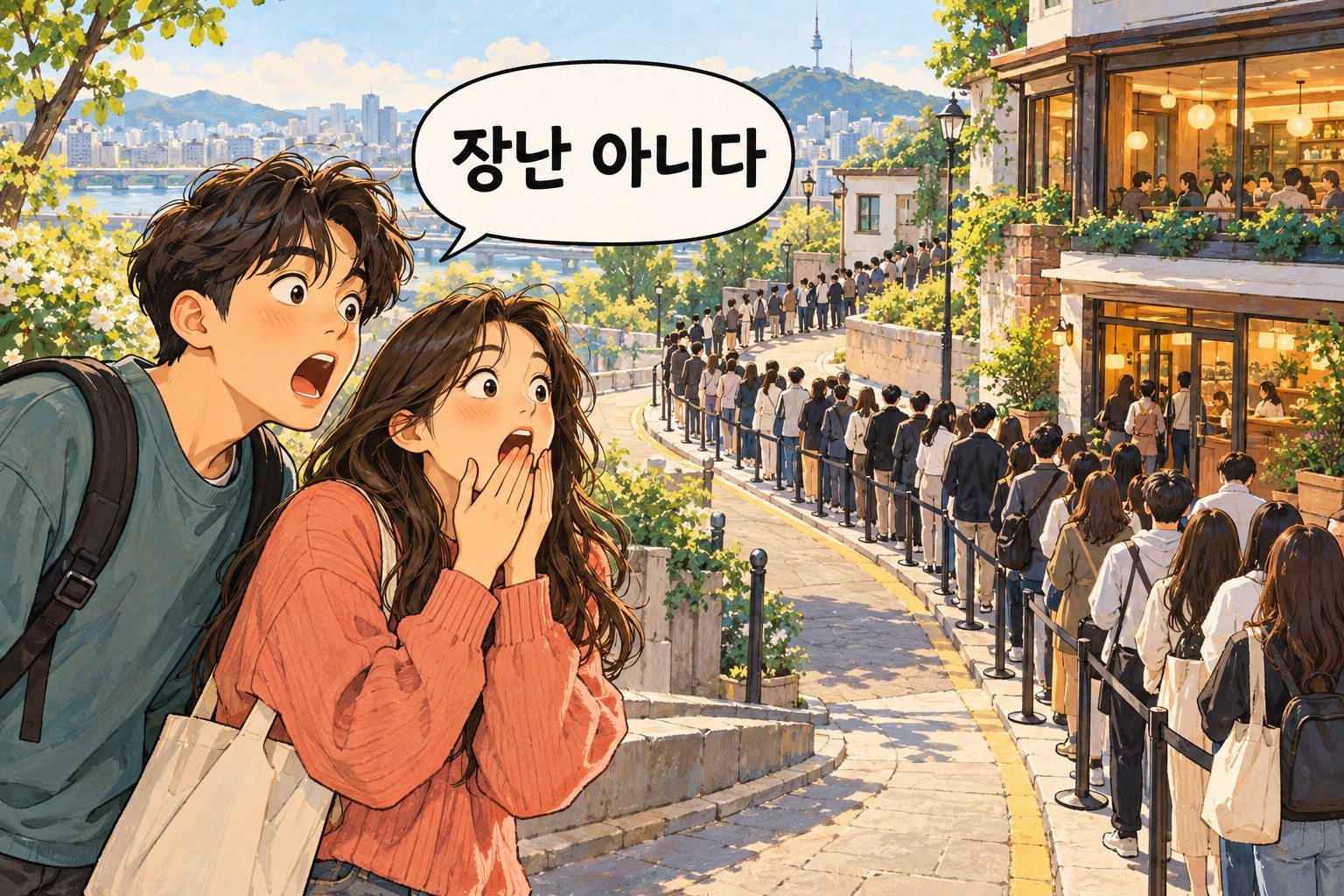
장난 아니다 (jangnan anida) — That is no joke; seriously intense.
This is lesson 10 in our Korean Slang series, adapted from Korean Your Teacher Doesn’t Teach You by Injin Hwang. The explanations below focus on understanding casual Korean and choosing an appropriate situation.
What 장난 아니다 means
Use 장난 아니다 for something unusually good, difficult, expensive or extreme. It can express praise or a complaint. The scene tells you which.
A short conversation
A: 오늘 사람 많다.
B: 대기 줄이 장난 아니야.
A: It is crowded today.
B: That queue is no joke.
How to understand the expression
장난 means a joke or playful mischief, while 아니다 means not to be. In this expression the combination stresses intensity. 장난 아니다 is the dictionary-style form; 장난 아니야 is the casual form in the dialogue. You can compare a positive scene, such as an impressive performance, with this crowded-cafe scene to hear how context changes the evaluation.
Use it with care
The meaning is figurative here. It does not necessarily accuse anyone of playing a prank. Use a clear polite description when the listener might misunderstand.
A more neutral or polite alternative: 대기 줄이 정말 길어요.
The waiting line is really long.
Try it yourself
In the sample, is the speaker praising a wonderful queue?
Show the answer
No. The speaker is emphasizing how exceptionally long it is.
Read both parts of the dialogue aloud. Then imagine a different situation and decide whether this reaction would sound friendly, exaggerated or unsuitable. Focus on the relationship between the speakers, not only the dictionary meaning.
Based on the author’s slang collection, with additional learning notes for this website. Illustration created with AI for this lesson.