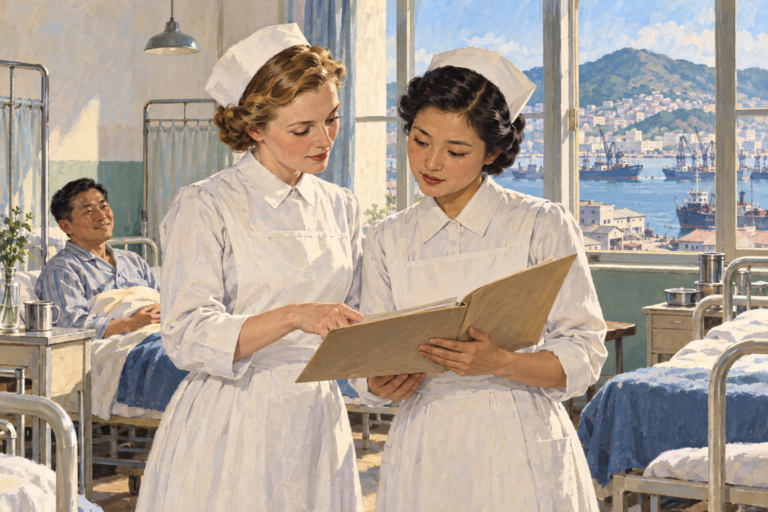
India’s Korean War story includes doctors close to the fighting and a separate mission dealing with prisoners after the armistice. Understanding the difference reveals a contribution that a list of combat units cannot fully explain.
The Indian medical unit that reached Busan
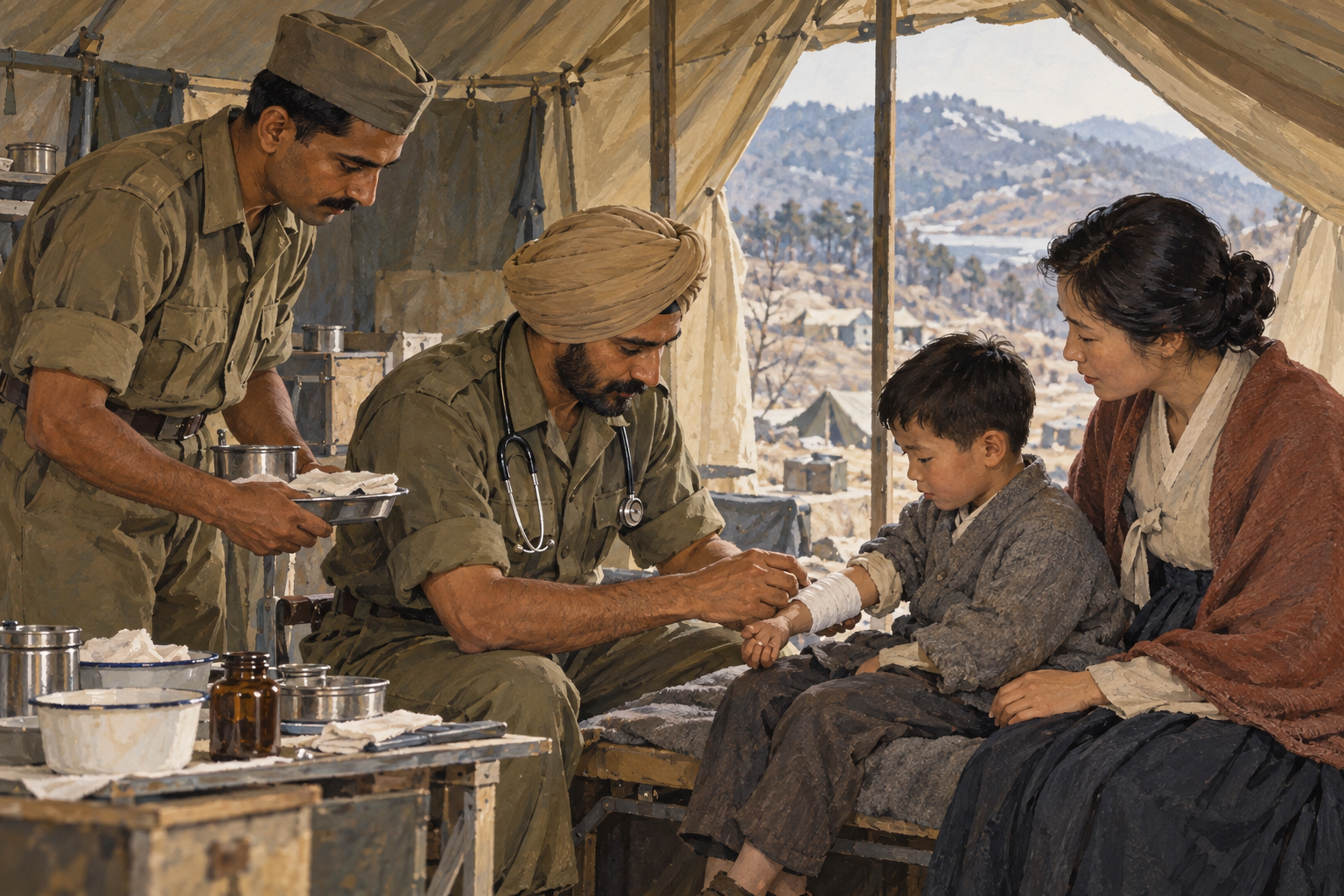
On 20 November 1950, the 60th Parachute Field Ambulance arrived in Busan under Lieutenant Colonel A. G. Rangaraj. Despite its name, a field ambulance was a medical unit, not simply a vehicle. Korea’s Ministry of Patriots and Veterans Affairs describes surgical and dental capabilities, supplies and transport within the Indian deployment. Read the ministry’s account of India’s medical participation.
The name is an easy source of confusion for a reader encountering this history for the first time. Imagining only an ambulance driving patients away leaves out the people who examined, treated and cared for them. It also hides the organization required to keep medical assistance available during a moving war.
Care near the fighting—and for civilians
The Indian embassy’s history describes the unit’s division into forward elements attached to the British brigade and a rear element in Daegu, which assisted a Korean Army hospital and treated civilians. That geography matters: the deployment connected the immediate needs of military operations with care farther from the front. See the Embassy of India’s account.
The Korean veterans ministry also records Indian personnel treating children with trachoma at an orphanage and arranging medicine from Japan. Alongside the unit’s wartime duties, this episode shows attention to an illness that did not depend on a battlefield injury. The ministry notes that the medical unit remained after the July 1953 armistice and left Korea in 1954. The participation history includes these civilian and post-armistice activities.
Medical history changes the questions we ask about a war. Instead of asking only which ground was taken, we can ask who received treatment, how supplies arrived and who remained when the fighting stopped. These questions do not replace military history. They restore experiences that a map of troop movements rarely makes visible.
India’s second role: prisoners of war
The prisoner question was one of the obstacles to an armistice. “Repatriation” means return to one’s country, but in Korea that apparently simple word concealed a difficult problem: what should happen to prisoners who resisted return?
A U.S. memorandum dated 18 May 1953 reveals the dispute while negotiations were still underway. It discusses a five-nation custodial commission staffed by Indian personnel, disagreements over immediate release, and safeguards against coercion. It is evidence of a contested negotiating process, not a description of a solution everyone already accepted. Read the contemporary memorandum in Foreign Relations of the United States.
After the armistice, India chaired the Neutral Nations Repatriation Commission. Lieutenant General K. S. Thimayya led the commission, while a separate Custodian Forces–India formation under Major General S. S. P. Thorat handled custody responsibilities. This was distinct from the earlier medical deployment. The Indian embassy outlines both missions.
Three distinctions that keep the story accurate
- Medical service and prisoner custody were different assignments. The field ambulance’s treatment work should not be confused with the later custodial force.
- A diplomatic contribution is not sole authorship of peace. India’s involvement belongs within negotiations among multiple governments and military commands.
- An armistice is a suspension of fighting. Calling the 1953 agreement a final peace treaty gives readers the wrong understanding of what it achieved.
These distinctions make appreciation more precise. The contribution is substantial without claiming that India alone ended the war or that all Indian personnel performed the same role. They also help explain why remembrance may feature both medical staff and soldiers associated with the prisoner arrangements.
How to read the sources
Begin with the Korean veterans ministry for the medical deployment, then compare the Indian embassy’s account for the wider bilateral perspective. Both are useful official histories written to explain and commemorate service. The American diplomatic document serves a different purpose: it records proposals and disagreements at a particular moment.
Reading them together is more informative than collecting the largest treatment total or the most dramatic tribute. A treatment count, for example, does not automatically tell us how many different individuals were treated. This article therefore concentrates on documented roles and places rather than using an impressive total without examining how it was counted.
Remembering a relationship through service
India’s story adds another dimension to K-DNA: international bonds can be remembered through medical skill and the difficult work of negotiation. Gratitude is strongest when it stays close to what people actually did.
Compare this contribution with Ethiopia’s Korean War service and its later relationship with Korea. The two histories differ in their military and diplomatic settings; placing them alongside each other helps reveal the range of countries and people involved in Korea’s past.
Source note: Linked Korean and Indian official histories establish the service record; a contemporary diplomatic memorandum provides context for the prisoner negotiations. The illustration depicts fictional people and is not evidence of a specific event.