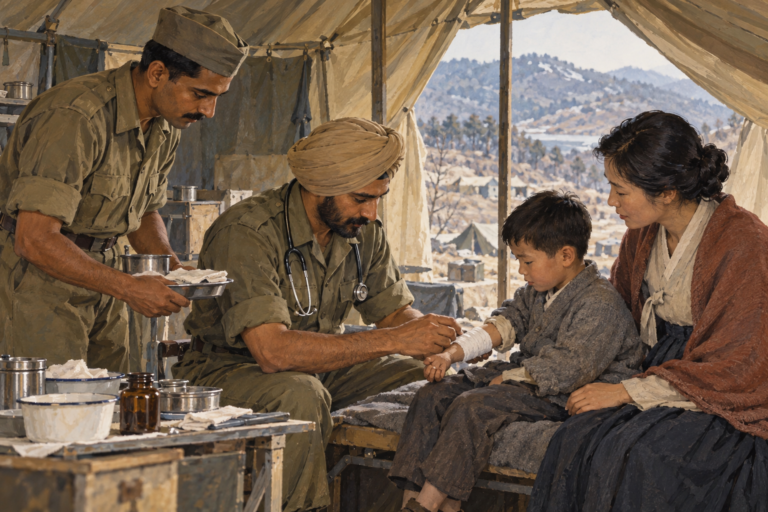
A Swedish hospital in wartime Busan and a public hospital in Seoul belong to different chapters of the same wider history. Between them lies an important change: from providing emergency care to helping build a lasting medical institution.
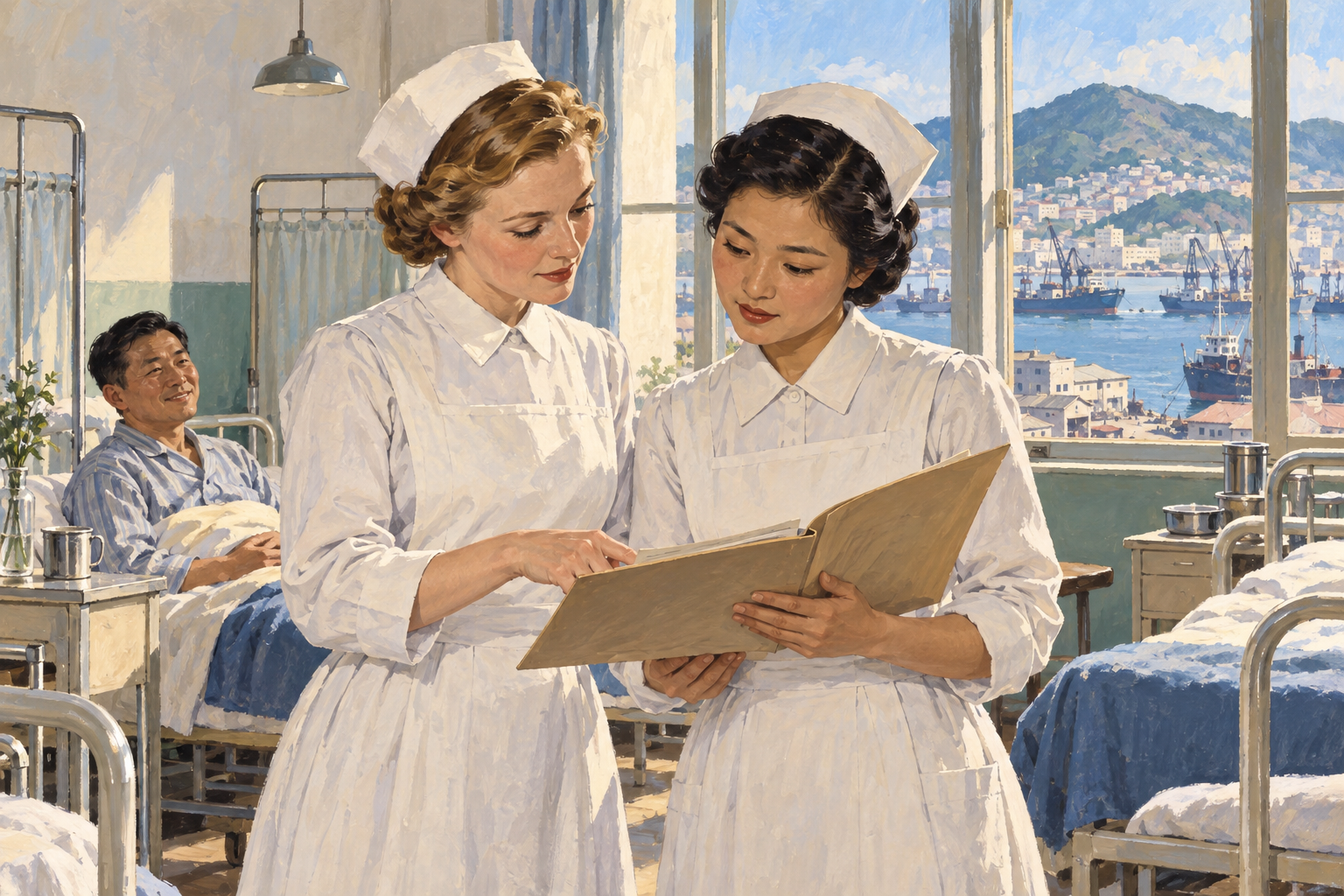
Swedish medical help arrived during the war
Sweden sent a Red Cross hospital to Korea in 1950. Based in Busan, it operated in a city that was central to the wartime movement of patients and relief. Historical research follows its development from a hospital serving wartime military needs toward a growing civilian role. The Swedish presence continued beyond the 1953 armistice, into 1958. See the study The Swedish Red Cross Hospital in Busan, 1950–1958.
That transition is the heart of the story. An armistice changes the military situation immediately, but a population’s need for treatment does not disappear on the day it is signed. A hospital can therefore have a second responsibility after its original emergency mission: deciding how to respond to people whose needs remain.
Three Scandinavian contributions, not one
Sweden’s hospital was part of a wider pattern of medical assistance. Denmark provided the hospital ship Jutlandia, while Norway sent the field hospital known as NORMASH. Research on the three Scandinavian countries examines how these different forms of wartime aid led toward later cooperation in Korea. Read the study in the Korean Journal of Medical History (PDF).
A ship, a field hospital and a hospital in Busan were not interchangeable institutions. Their locations and operating arrangements differed. Keeping their names separate makes it easier to understand why the later joint project represented cooperation among distinct partners, rather than the expansion of one country’s operation.
From wartime treatment to a national medical center
The Norwegian embassy traces discussions of postwar medical assistance to Scandinavian representatives in Korea in 1951. An agreement followed in March 1956 among the Scandinavian governments, the United Nations Korean Reconstruction Agency (UNKRA) and Korean authorities. The National Medical Center opened in Seoul in 1958. Its intended role included public medical services and improvements in medical standards. Read the embassy’s history of the joint project.
The National Medical Center’s own account also identifies Denmark, Norway and Sweden alongside UNKRA and the Korean government. It explains the institution’s treatment and training purposes. This is why describing the center simply as “a hospital Sweden gave Korea” would leave out essential partners and the Korean side of the undertaking. See the National Medical Center’s institutional history.
A short timeline of the transition
- 1950: The Swedish Red Cross hospital begins its Korean War service in Busan.
- 1953: The armistice suspends fighting; continuing civilian medical needs remain part of the postwar challenge.
- 1956: An agreement establishes the framework for the National Medical Center project.
- 1958: The National Medical Center opens in Seoul.
- 1968: The hospital is handed over to Korean authorities; Scandinavian assistance continues for a further period.
The Norwegian embassy records that assistance continued until 1971 after the 1968 handover. Its history also describes exchanges of medical personnel and Korean participation in training in Norway. Those connections help explain why the project’s significance extended beyond the original building. See the sections on hospital operation and personnel.
Why training belongs in a story about aid
A bed makes treatment possible for one patient at a time. Training changes what a professional can do for many patients over a career. When an institution combines the two, its value cannot be measured only by the number of people treated during its opening years.
This is an interpretation of the project’s importance, rather than a claim that one overseas program created Korea’s healthcare system. Korean professionals and institutions had their own knowledge, responsibilities and development. The more useful question is how collaboration added to that work—and how responsibilities were transferred as circumstances changed.
It also changes the way we use the word “legacy.” A commemorative plaque records that help arrived. A continuing institution raises a further question: what could people keep doing after the original overseas staff had left? In this case, public service, professional education and exchange are central to understanding the relationship.
Two hospitals and two cities: a useful reading guide
When following this history, keep Busan’s Swedish Red Cross hospital distinct from Seoul’s National Medical Center. They are related through the history of medical assistance, but they are not the same hospital under a new name. Likewise, Sweden’s hospital service should not be confused with the separate diplomatic and armistice-related commissions in which Sweden participated.
For a first reading, use the hospital study to understand the Busan transition, the Scandinavian medical-history paper to compare wartime contributions, and the institutional and embassy histories to follow the Seoul project. Together, they give a clearer picture than a single anniversary anecdote.
Explore another form of international service in our K-DNA stories, including Ethiopia’s relationship with Korea. Here, cultural memory means remembering a partnership accurately—and recognizing everyone who helped sustain it.
Source note: This article uses medical-history research and official institutional histories. The illustrated ward is an imagined scene with fictional staff, not a reconstruction of a documented photograph.