Chuseok is one of Korea’s most important holidays: a time associated with the autumn harvest, family gatherings, and remembering previous generations. If you are visiting Korea, you may notice gift boxes in shops, busy train stations, and small crescent-shaped rice cakes on sale. All are clues that the holiday is approaching.
In 2026, Chuseok falls on Friday, September 25. This guide explains when it happens, what people do, which foods to try, and how to join the season respectfully as a visitor.
When is Chuseok?
Chuseok takes place on the 15th day of the eighth month of the Korean lunar calendar. It usually falls in September or October on the Gregorian calendar, so its date changes each year. “The eighth month” here does not mean August on your everyday calendar.
| 2026 date | What it means |
|---|---|
| Thursday, September 24 | First day of the three-day Chuseok public holiday |
| Friday, September 25 | Chuseok Day |
| Saturday, September 26 | Final day of the three-day Chuseok public holiday |
| Sunday, September 27 | Following Sunday; some cultural events continue |
You may also hear Hangawi (한가위), another name for Chuseok. The holiday is closely associated with the autumn full moon and the abundance of the harvest. The National Folk Museum connects its history with older seasonal celebrations, including the Gabae tradition recorded in accounts of the Silla period.
Is Chuseok “Korean Thanksgiving”?
“Korean Thanksgiving” is a helpful introductory description because Chuseok involves gratitude, seasonal food, and family. However, it has its own history, calendar, and customs. It is not a Korean version of the American holiday, and a turkey dinner is not its defining tradition.
Think of the phrase as a starting point. Learning the words Chuseok, songpyeon, and seongmyo gives you a much clearer picture of what the holiday means in Korea.
What do people do during Chuseok?
Meet family and share a meal
Many people travel to their hometowns to see parents and relatives. Eating together, talking, and exchanging gifts can be central parts of the visit. These homecoming journeys help explain why intercity travel becomes so busy.
There is no single modern Chuseok routine. Some households prepare a large meal, others buy prepared dishes, and some use the break for travel or rest. Religious beliefs, family preferences, work schedules, and personal circumstances all affect how people spend the holiday.
Remember ancestors: charye, seongmyo, and beolcho
These three terms describe related but different customs:
- Charye (차례): a holiday ancestral memorial rite. In families that observe it, food is arranged as an offering and respects are paid to ancestors.
- Seongmyo (성묘): visiting ancestral graves to remember and honor deceased family members.
- Beolcho (벌초): clearing weeds and tending the area around ancestral graves, often before Chuseok.
A family may follow these customs closely, simplify them, or not observe them. As a guest, ask your host what their family does rather than assuming that a ritual is part of every invitation.
Enjoy traditional performances and the holiday atmosphere
Public celebrations may include folk games, music, and performances. Ganggangsullae, a traditional circle dance associated with Chuseok, involves people joining hands, singing, and moving together. Ssireum, Korean wrestling, is another tradition connected with festive gatherings.
These are useful things to look for at a cultural event, but they are not activities that every household performs. A festival offers a public introduction to traditions that may be less visible in an ordinary family meal.
What foods do people eat at Chuseok?
Songpyeon: the signature rice cake
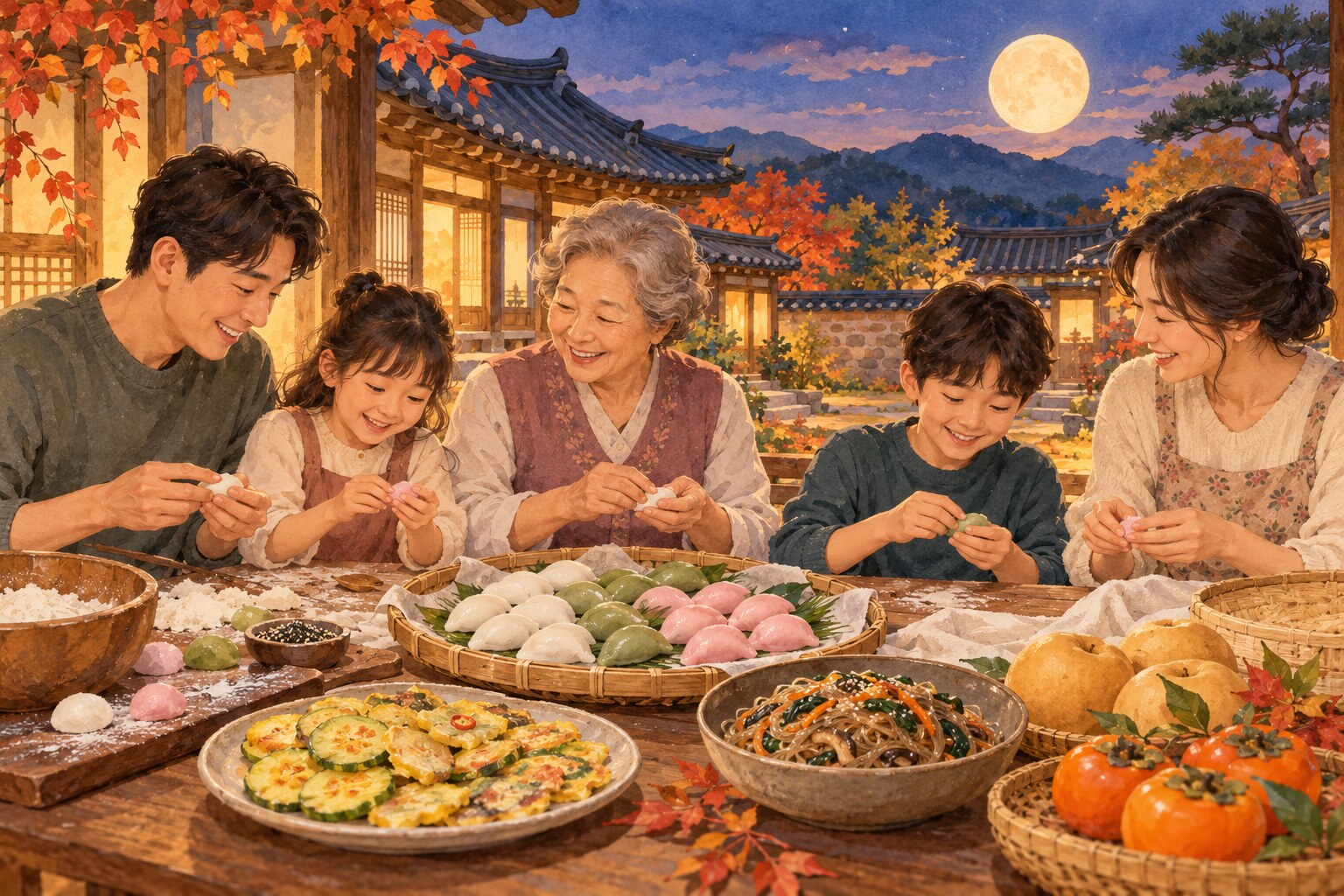
Songpyeon (송편) is the food most closely associated with Chuseok. Rice-flour dough is wrapped around a filling and shaped into small half-moons or crescents. Fillings vary and can include sesame, beans, or chestnuts.
Traditionally, songpyeon is steamed with pine needles, which add a distinctive scent. Shapes, colors, and fillings differ across regions and households. Some families make the rice cakes together; others buy them from a rice cake shop.
For a first taste, ask which filling is inside rather than choosing by color alone. Our guide to Korean rice cakes explains how songpyeon fits into the wider world of tteok.
Jeon: savory food from the frying pan
Jeon (전) covers several kinds of savory pan-fried food. A holiday plate might contain egg-coated slices of zucchini, fish, or small meat patties. It does not always look like one large pancake.
Japchae: glass noodles with vegetables
Japchae (잡채) combines glass noodles with vegetables and seasoning; some versions include meat. It is a familiar dish at celebrations and family meals, including Chuseok.
Fruit and sweets
Apples and Korean pears are familiar holiday gifts and foods. Yakgwa (약과), a sweet traditional confection, may also appear. The menu varies, and many of these foods are enjoyed at other times of year too; songpyeon has the especially strong Chuseok connection.
A practical food tip: Tell your host or seller about dietary restrictions before eating. A vegetable-looking dish may contain egg or meat, and fillings and sauces vary. Asking what is inside is more useful than guessing from a photograph.
If you are invited to a Korean home
Ask your host what time to arrive and whether you should bring anything. A modest gift chosen with the household in mind is a thoughtful option, but there is no need to buy an elaborate holiday gift set simply because a shop displays one.
Follow your host’s lead about shoes, seating, and the meal. Offer to help with preparation or clearing the table, and ask before photographing a family ceremony. If you are unfamiliar with a custom, a polite question is better than pretending to know what to do.
You can use either of these friendly, polite greetings:
- 즐거운 추석 보내세요. — Have a wonderful Chuseok.
- 풍성한 한가위 보내세요. — Wishing you an abundant Hangawi.
The second greeting reflects the holiday’s harvest imagery. You can write either in a message to a Korean friend, teacher, or host.
Where visitors can experience Chuseok in Seoul in 2026
You do not need a family invitation to enjoy a public celebration. Seoul Metropolitan Government lists these events for the 2026 holiday:
- Namsangol Hanok Village: the Namsangol Chuseok Festival runs September 25–27, from 10 a.m. to 8 p.m. Its program includes traditional music, cultural experiences, and a food market.
- Unhyeongung: its Hangawi program runs September 24–27, from 11 a.m. to 5 p.m., with traditional games, crafts, and performances.
Some experiences require payment. These are event hours, not necessarily the venues’ full opening hours. Check the official Seoul holiday guide and venue notices before you go, since individual activities can have separate schedules or booking requirements.
What travelers should plan around
Allow for sold-out intercity trains and buses, road congestion, and holiday closures. City subways and buses continue to operate, but individual venues set their own hours. In particular, do not assume that a museum is open on Chuseok Day simply because it has a holiday program on another date.
Parts of Seoul can feel calmer as residents leave, while popular events remain busy. For a wider view of holiday timing and seasonal weather, see our best and worst times to visit Korea guide.
A simple first Chuseok plan is enough: try a few songpyeon, visit one confirmed cultural event, and send a warm holiday greeting. Understanding the meaning behind these small experiences can make the day more memorable than trying to see every attraction.
Sources and further reading
- Korea Tourism Organization: 2026 Chuseok Holiday Travel Guide — current dates and travel information.
- National Folk Museum of Korea: Chuseok seasonal customs — cultural background; its displayed Gregorian date is a historical example.
- Korea Tourism Organization: Traditional Chuseok customs — background on rituals and folk traditions, not current event dates.
- Korea.net: Regional songpyeon varieties.
- Korea.net: How Chuseok customs change.
- Seoul Metropolitan Government: 2026 holiday events.
Dates and event information checked September 24, 2026. Featured image: original AI-generated illustration of a family making songpyeon; not a photograph of an actual family or event.