Korean minhwa can feel immediately approachable: a tiger with an unforgettable expression, flowers larger than life, or books arranged into a vivid decorative world. You can enjoy that first impression and still find more to explore.
Minhwa (민화) is commonly translated as Korean folk painting. Many works express wishes, humor, or ideas connected with everyday life. This guide offers a starting point for looking, rather than a dictionary that assigns one unchanging meaning to every image.
Start with what you actually see
Before reading a label, spend a moment naming the visible subjects. Which animal or object catches your attention? Is the arrangement balanced, crowded, playful, or solemn? Notice the relationship between the subjects as well as the subjects themselves.
Then read the label and look again. You may discover a ceremonial use or a historical context that changes your first impression. That second look is where a museum visit often becomes interesting.
Three subjects that open a conversation
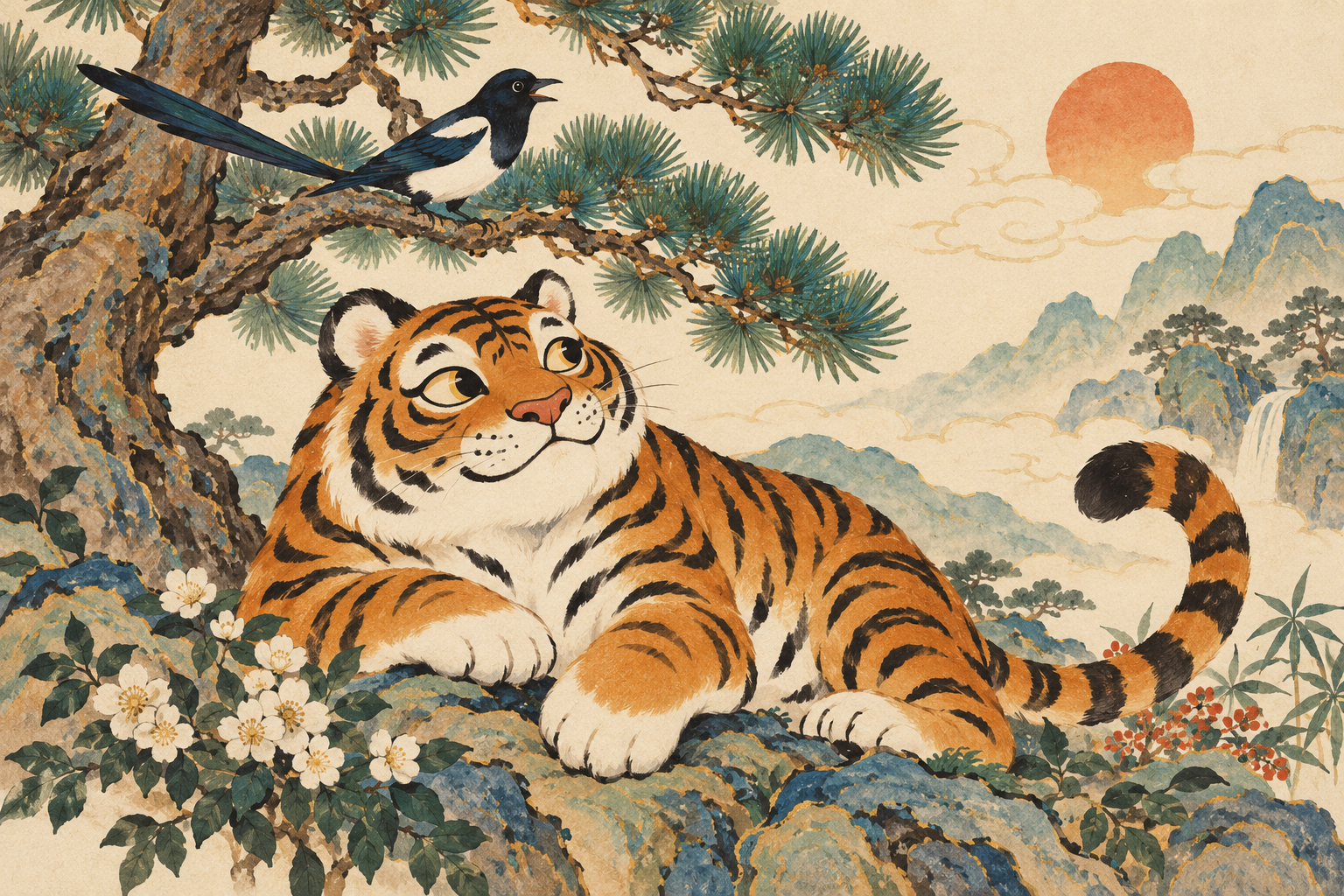
Tigers and magpies: this familiar pairing appears in Korean folk painting. Some tigers are wonderfully comic rather than naturalistic. Notice the expression, posture, and distance between the animals before settling on an interpretation.
Peonies: the National Palace Museum explains their association with wealth and honor across social classes. It also shows that peonies appeared in royal and ceremonial settings. A beautiful flower can carry different meanings depending on the object and its use.
Books and objects: paintings known as chaekgeori place books and related objects at the center of attention. Look at how the artist arranges them and creates a sense of space. Not every picture needs to follow the perspective you would expect in a photograph.
Read the object label as carefully as the image
Before describing a painting as representative of all Korean folk art, check its date, material, format, and attribution. A folding screen, a hanging scroll, and a modern souvenir print invite different kinds of use. A shared subject does not make them interchangeable evidence about the past.
The tiger-and-magpie illustration on this page is a modern AI-generated interpretation. It introduces a recognizable theme, but it cannot establish how a historical artist worked or what a particular original meant. Compare it with an identified museum object when studying the tradition. The useful distinction is between enjoying an inspired image and using a documented artifact as a historical source.
Do not turn the painting into a code puzzle
It is tempting to ask, “What does the tiger mean?” and move on once you receive an answer. A more useful question is, “What is this tiger doing in this particular painting?”
Compare two examples. A change in expression, surrounding objects, or composition may change the mood even when the central animal stays the same. Interpretations such as protection, good fortune, or social satire should be connected to the specific work and its curatorial explanation.
Try a ten-minute viewing activity
- Choose one painting instead of trying to study an entire room.
- Write down three visible details without interpreting them.
- Read the title, date, material, and explanation.
- Return to your notes and add one thing the label helped you understand.
- Choose a second painting with a similar subject and compare its mood.
This activity is useful for language learners, too. A small set of concrete nouns is easier to remember when connected with an image you have examined closely.
Buying a print or joining a class
Ask whether an item is a reproduction of a historical work, a contemporary artist’s painting, or a new design inspired by minhwa. These are different kinds of objects, and a clear description helps you choose what you want.
For a workshop, ask whether the design is supplied, which materials you will use, and whether your work can be packed immediately. A beginner class may focus on coloring an outline; confirm the activity if your aim is to learn composition or drawing.
Words to remember
- 민화 — Korean folk painting
- 호랑이 / 까치 — tiger / magpie
- 모란 — peony
- 이 그림에 대해 설명해 주세요. — Please tell me about this painting.
For another tradition that rewards close looking, explore Korean decorative knots.
Sources and further reading
- National Palace Museum of Korea: Peonies, Flowers of Peace and Prosperity
- Horim Museum: Tiger and Magpie
- The Metropolitan Museum of Art: Korean Munbangdo Paintings
The viewing exercise and workshop questions are our editorial suggestions.
Prepared September 25, 2026. Illustration: original AI-generated interpretation, not a documentary photograph or a reproduction of a historical artwork.