Korean hanji paper invites you to notice something most of us handle without thinking: the material beneath the words. In a notebook, a paper-covered object, or a softly lit shade, the paper itself can be part of the experience.
This beginner’s guide gives you a way to look at hanji, ask useful questions, and choose a craft activity without needing a background in Korean art.
What is hanji?
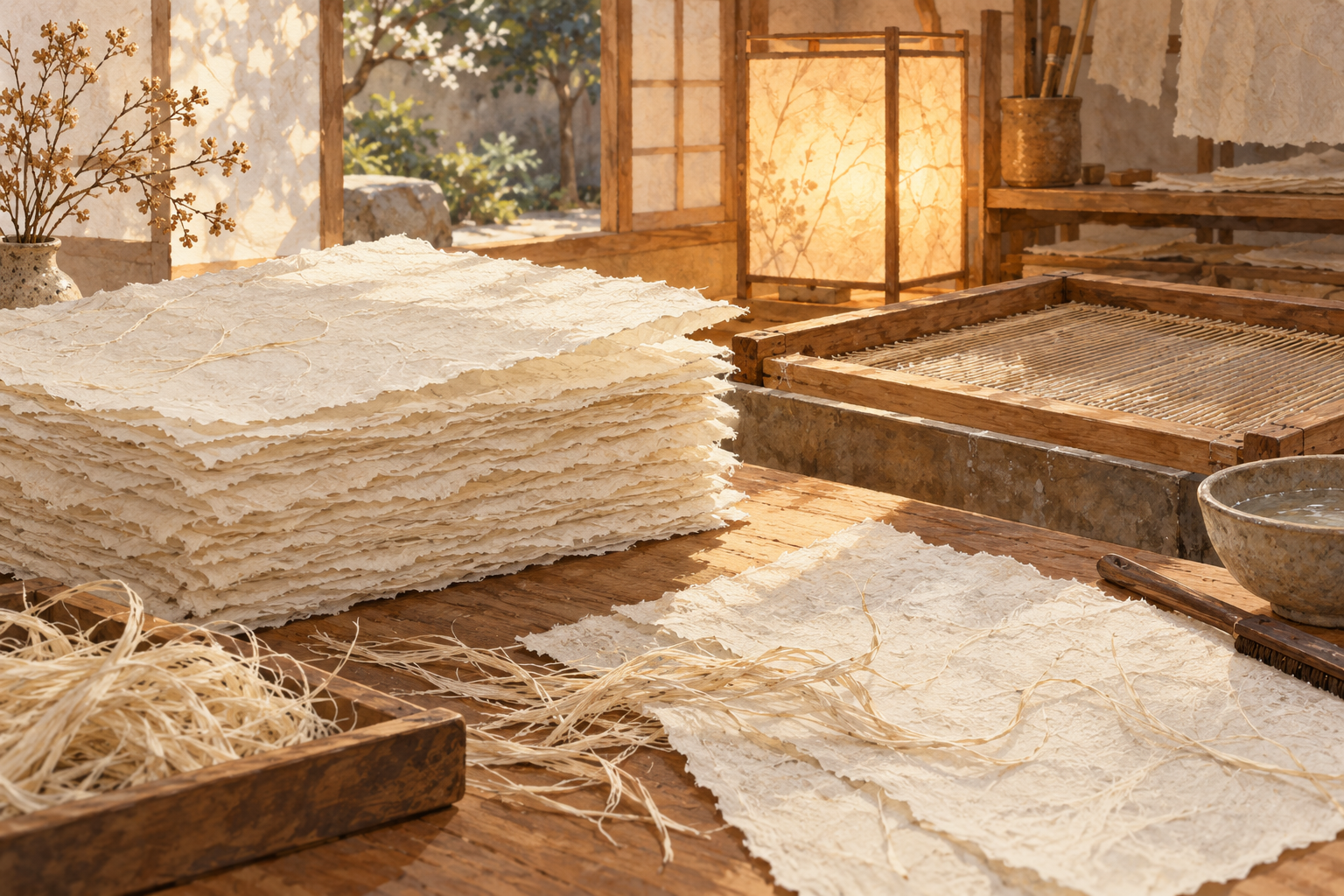
Hanji (한지) is traditional Korean paper, made primarily using bark fibers from the paper mulberry, called dak. Preparing the fibers and turning them into sheets involves several stages, including steaming, peeling, pounding, sheet forming, and drying. The finished sheet represents a sequence of skilled decisions, not simply a decorative surface.
The Korean Cultural Center New York describes hanji as a mulberry-fiber paper and shows how contemporary artists use it beyond conventional writing surfaces. The connection between plant fiber and artistic practice matters: hanji is both a material with a craft history and a medium that makers continue to explore.
Try a three-part looking exercise
When a shop or workshop provides a sample that you may handle, compare it with ordinary writing paper. Ask permission before touching display pieces.
- Look at the surface. Can you distinguish individual fibers? Is the texture consistent, or does it change across the sheet?
- Look toward the light. Hold an approved sample near a light source and notice how much light passes through. Compare two samples of different thicknesses.
- Think about its purpose. Would you choose that sheet for drawing, wrapping, or a decorative object? Your answer may change when you imagine the finished item.
These observations are a way to appreciate material, not an authenticity test. A rough edge or visible fiber alone cannot tell you exactly how or where a product was made.
From a sheet to an object
Our illustration places paper beside a softly glowing shade. Use that pairing as a design question: what changes when paper transmits light instead of carrying ink? A sheet selected for a lampshade and one chosen for brushwork need not have the same thickness, finish, or behavior. The material’s purpose should guide your questions more than its appearance in a photograph.
For an introduction in Seoul, Hanji House is a useful starting point. The Korea Craft & Design Foundation describes it as a space bringing together information on Korean hanji workshops and paper types. Consult its current program before visiting; a display, a shop visit, and a scheduled hands-on class are different experiences.
Choose a workshop by the activity
“Hanji experience” can describe different activities. Before booking, ask whether you will form a sheet from pulp, decorate a ready-made object, or work with finished paper. Each can be enjoyable, but they teach different skills.
If you want to understand papermaking, choose a program that explicitly includes sheet forming. If you want a small finished souvenir, ask about a project you can complete and carry away that day. Confirm drying time, instruction language, and what is included in the price.
Questions to ask before buying
Start with how you plan to use the item. For a notebook, ask whether the paper suits your preferred pen. For a decorative object, ask how to dust it and whether it should be kept away from moisture. If the maker’s story matters to you, request the maker’s name and information about the paper.
Do not assume that every product labeled hanji has the same fiber composition or production method. Clear information is more helpful than a vague promise of “traditional quality.”
A little Korean for the shop
- 한지로 만들었어요? — Is it made with hanji?
- 직접 만들어 볼 수 있어요? — Can I try making it myself?
- 어떻게 보관해요? — How should I store it?
For another material-based tradition, read our guide to Korean bojagi wrapping cloth. Compare what you notice first: the material, the pattern, or the way the object is used.
Source and further reading
Korean Cultural Center New York: Re:visioning HANJI; Korea Craft & Design Foundation: Hanji House; Korea Tourism Organization: Hanji House. The looking exercises and shopping questions above are our editorial suggestions.
Prepared September 25, 2026. Illustration: original AI-generated interpretation, not a documentary photograph or a reproduction of a historical artwork.