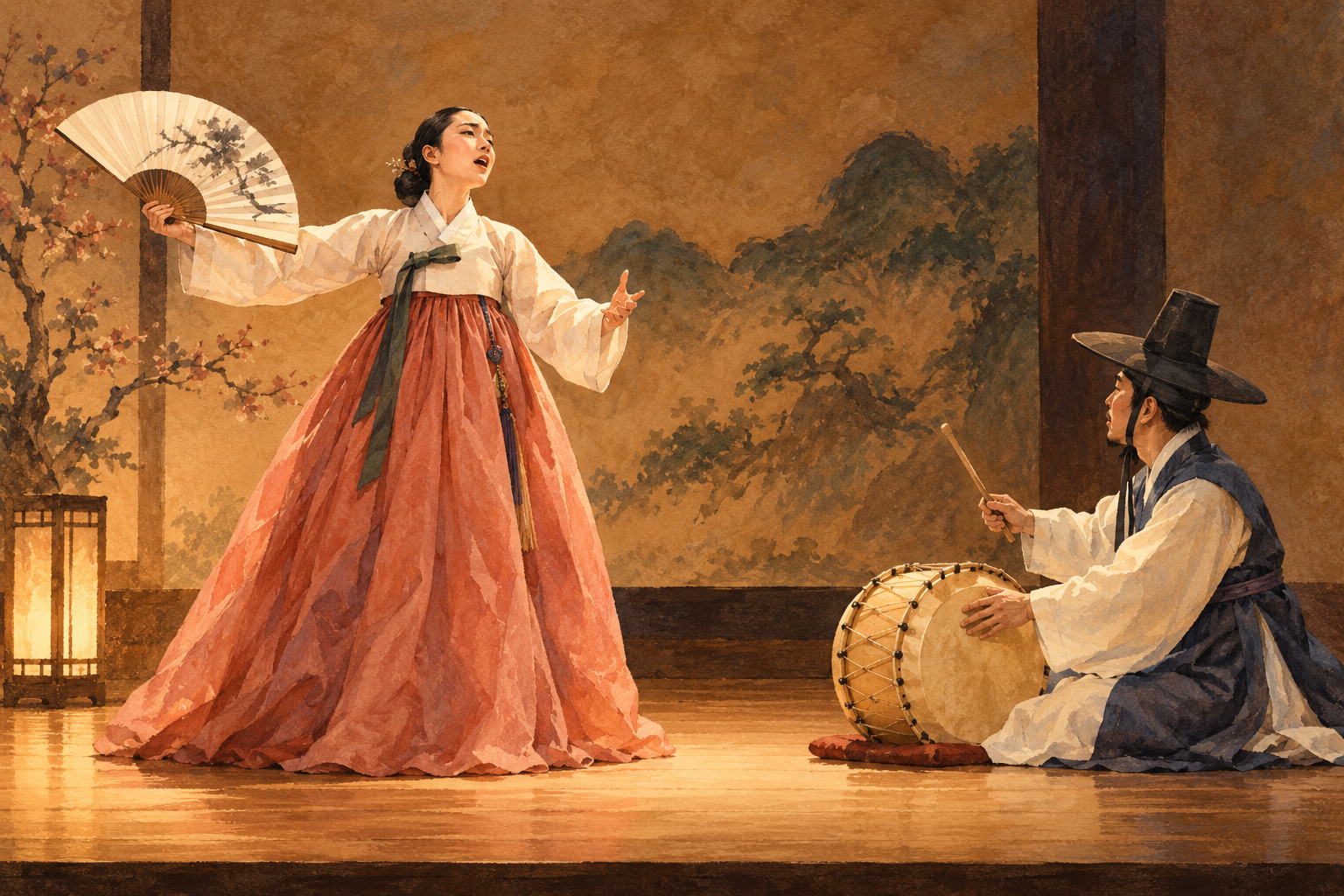
This guide to pansori for beginners starts with a simple invitation: listen for a story, not just a melody. A single singer and a drummer can hold your attention through changes of voice, pace, gesture, and mood.
You do not need to understand every word to begin. Knowing the situation in a scene gives you something to follow while your ears become familiar with the sound.
What is pansori?
Pansori (판소리) is a Korean form of musical storytelling performed by a vocalist and a drummer. Expressive singing, stylized speech, and gesture work together to present a narrative. The singer’s training includes demanding vocal technique and a substantial repertoire.
UNESCO originally proclaimed pansori in 2003; it entered the Representative List of the Intangible Cultural Heritage of Humanity in 2008. UNESCO also describes performances lasting many hours. That does not mean your first encounter needs to be a complete extended performance: check whether a program presents an excerpt, an introduction, or a longer work.
Three terms that help you follow a scene
A useful starting vocabulary is sori (singing), aniri (spoken narration), and neoreumsae (expressive gesture). These elements let a performer explain a situation, inhabit a character, and intensify an emotion without a large cast or elaborate scenery. The Korea Tourism Organization uses these terms in its introduction to the art.
For your first excerpt, try marking the changes: when does speech turn into song, and what does the body do at that moment? This gives you a concrete listening task even before you can follow the Korean. It also helps you avoid treating a spoken passage as an interruption; narration is part of the performance.
Listen to the voice in three ways
As sound: notice the texture of a sustained note and how the performer moves into the next phrase. You do not need to decide immediately whether the sound resembles another singing style you know.
As a character: listen for changes that suggest a different speaker or emotional position. Ask whether a passage sounds pleading, teasing, proud, or distressed, then compare your impression with the synopsis.
As a storyteller: notice how the performance moves between moments of explanation and musical intensity. A shift in delivery may help you recognize that the scene is moving forward.
Give the drummer your attention
It is easy to watch only the singer. For a short stretch, focus on the drummer instead. Notice how the rhythmic accompaniment relates to the singer’s phrasing and where the two seem to create a shared pause or renewed momentum.
Then widen your attention to both performers. This listening exercise can make a sparse stage feel much more active. You are following a relationship rather than counting the number of instruments.
Prepare with a short synopsis
Before listening, write down who is involved, what the central problem is, and where the selected scene fits into the story. Three clear sentences can be more useful than a long plot summary.
If subtitles are available, use them as support. Read enough to understand the situation, then look back at the singer. Facial expression and gesture may carry information that a translation cannot fully reproduce.
A twenty-minute introduction at home
- Spend a few minutes reading an introduction to the scene.
- Listen to a short official or authorized recording without pausing.
- Choose one moment that caught your attention and replay it.
- Listen again while focusing on the drummer.
- Write one sentence about how your impression changed.
This is our suggested learning activity, not a required performance format. If a scene leaves you curious, continue with more of the same work before jumping between many unrelated clips.
Before attending a performance
Check the advertised length, whether there is an interval, and whether English interpretation or subtitles are provided. A program labeled “traditional Korean music” may contain several genres, so read the actual performance list if pansori is your main interest.
Follow the venue’s guidance about audience participation, photography, and recording. If a host explains how to respond, use that guidance rather than assuming every theatre follows the same convention.
Useful Korean
- 소리꾼 — singer, often used for a traditional singer
- 고수 — the drummer accompanying pansori
- 북 — drum
- 어떤 이야기예요? — What is the story about?
Interested in another performance where movement and storytelling meet? Explore our introduction to talchum.
Source and further listening
UNESCO: Pansori epic chant, including its introductory video. See also the Korea Tourism Organization’s introduction to pansori for performance terminology. The listening exercises above are our own suggestions.
Prepared September 25, 2026. Illustration: original AI-generated interpretation, not a documentary photograph or a reproduction of a historical artwork.