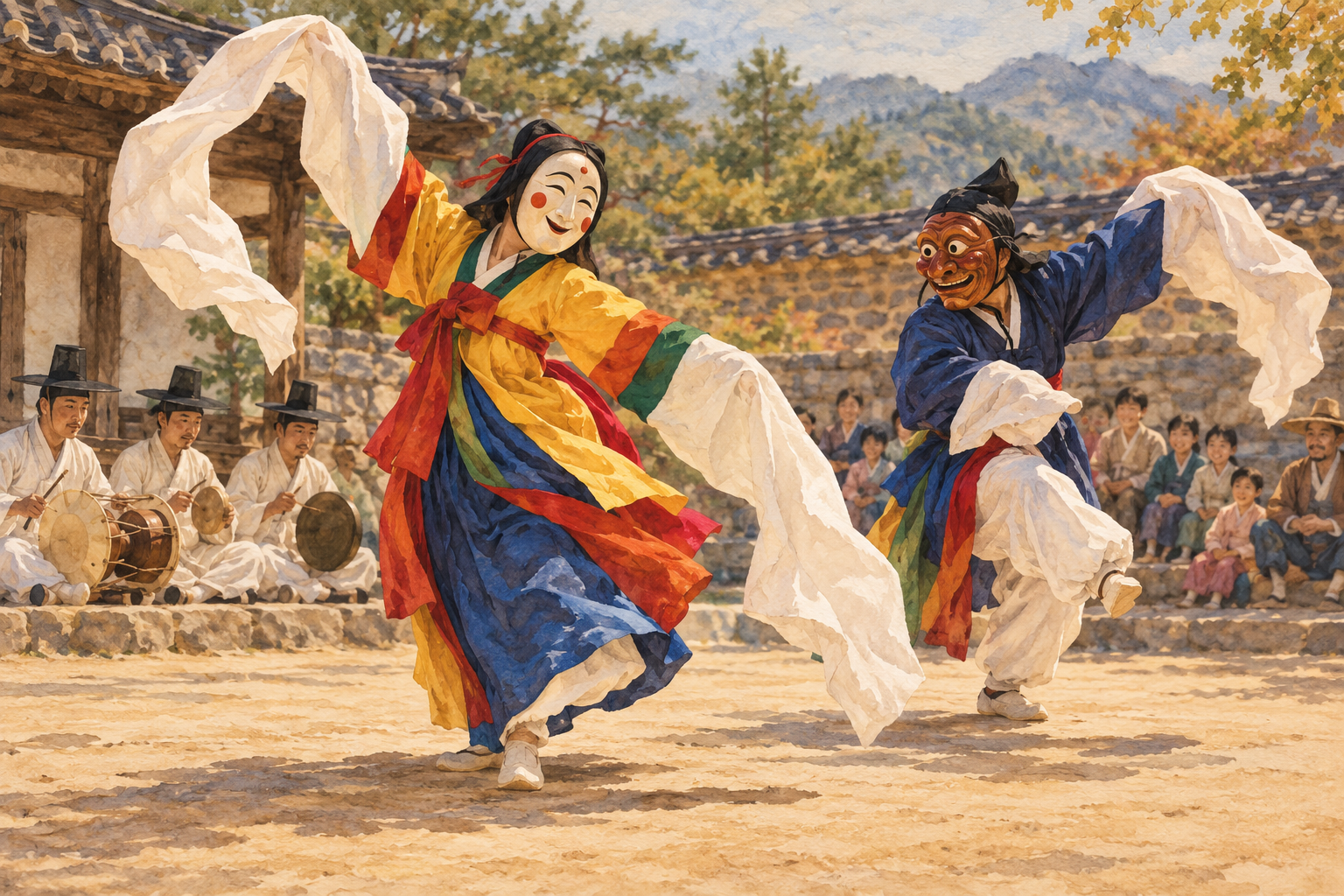
Korean talchum mask dance is much easier to appreciate when you watch the whole exchange: a performer moves, a musician responds, and the audience reacts. The mask is striking, but it is only one part of the event.
If you do not speak much Korean, you can still follow gesture, rhythm, and the relationship between characters. A short explanation of the scene will help you understand more of the humor.
What is talchum?
Talchum (탈춤) combines masked performance with dance, music, and theatre. UNESCO describes its use of humor and exaggerated characters to explore social issues and criticize hierarchy. Audience responses are part of the performance, and local traditions can include regional dialects and songs.
Talchum was inscribed on UNESCO’s Representative List of the Intangible Cultural Heritage of Humanity in 2022. The living tradition includes performers, musicians, mask makers, teachers, and the communities that transmit their knowledge.
Learn the name of the local tradition
Talchum is a useful umbrella term, but it should not erase local identities. The UNESCO-linked heritage inventory lists communities associated with forms such as Bongsan Talchum, Hahoe Byeolsingut Talnori, and Tongyeong Ogwangdae. A program’s specific name is a clue to what you are watching, not an optional detail.
Keep that name with your photographs or notes. If you later search for a performance video, it will help you find a relevant example rather than an unrelated mask dance. Our illustration is an imaginative introduction to masked performance, not a documentary depiction of one named local form.
Watch how the body changes the face
A mask does not need to change physically for its expression to seem different. Watch what happens when a performer tilts their head, pauses, turns away, or changes posture. Try following one performer through a short scene instead of shifting your attention constantly.
Ask yourself: who appears confident, who seems nervous, and who is mocking whom? These are questions for observation, not fixed character identifications. Check the program to learn which roles you are actually seeing.
Listen to the audience
UNESCO highlights cheers and other audience reactions as part of talchum’s shared experience. Notice when people respond and how that response affects your attention.
For your own participation, follow the host’s guidance and the setting. An outdoor community performance and a formal theatre presentation may invite different behavior. You can enjoy the interaction without trying to imitate every shout immediately.
Prepare for the scene, not an exam
Before watching, find three pieces of information: the name of the performance tradition, the main characters in the scene, and the situation they are arguing or joking about. A small amount of context can make gestures far more readable.
If the program offers subtitles or a synopsis, read the scene summary first and glance at the translation when necessary. Spending the whole time looking at text can make you miss the movement that gives the words their force.
A first-viewing plan
- Read the available scene introduction.
- Watch one complete scene without filming it.
- Notice a moment when the audience reacts strongly.
- Afterward, use the program or a guide to understand that moment.
Recordings can help you revisit what you saw, but follow the venue’s filming rules. Keep walkways clear and avoid holding a phone in front of other viewers.
A mask souvenir is a starting point
If you buy a mask or a miniature, ask which tradition or character inspired it. A decorative souvenir may be a modern adaptation rather than a performance object. Knowing that distinction makes its story clearer.
A useful next step is to look for a recording of the relevant tradition. Seeing a similar face in movement can connect the object on your shelf with the performance that inspired it.
Useful Korean
- 탈 — mask
- 공연 — performance
- 어떤 인물이에요? — What character is this?
- 영어 설명이 있어요? — Is there an explanation in English?
For another introduction to expressive faces in Korean culture, read about jangseung village guardians. They belong to a different tradition, so enjoy comparing their visual character without treating them as the same kind of object.
Source and further viewing
UNESCO: Talchum, mask dance drama in the Republic of Korea, including its introductory video. See also ICHCAP ichLinks: Talchum and its transmission communities. The viewing plan above is our suggestion.
Prepared September 25, 2026. Illustration: original AI-generated interpretation, not a documentary photograph or a reproduction of a historical artwork.