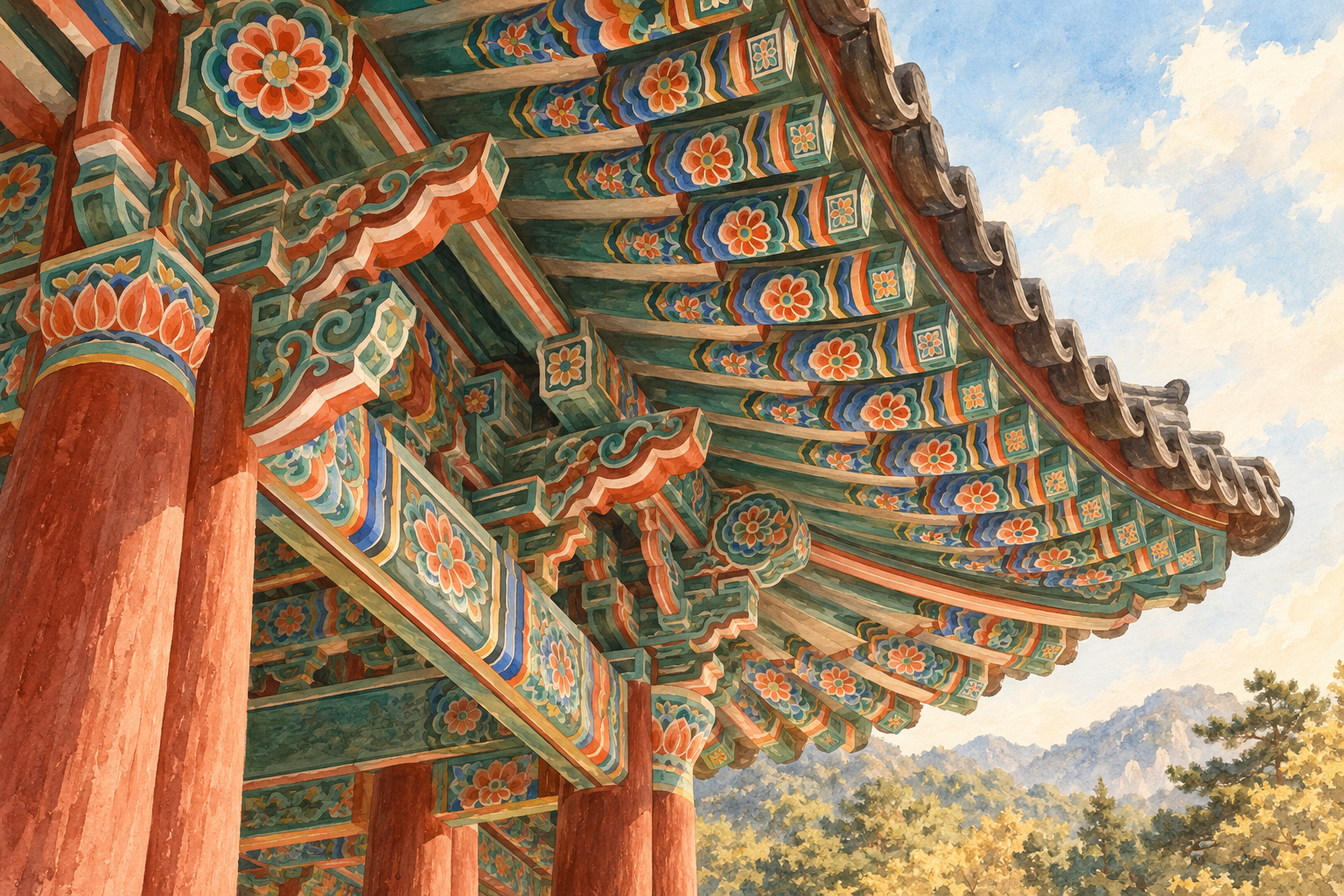
Korean dancheong is a good reason to look up. Beneath the roof of a temple or palace building, painted beams and brackets can create a world of color that is easy to miss when you are concentrating on the courtyard ahead.
You do not have to identify every motif to enjoy it. A few minutes spent following a line or comparing two sections can make a building feel much more memorable.
What does dancheong mean?
Dancheong (단청) refers to traditional decorative coloring on Korean wooden buildings and objects. It has practical as well as visual purposes: painted finishes help protect wooden surfaces, while patterns contribute to a building’s character.
Korea.net’s introduction connects the tradition to the five cardinal colors—blue, red, yellow, white, and black—and to the philosophy of the five elements. The actual painted surfaces may contain many additional shades. Think of the five colors as a cultural framework, not a rule that limits every building to five paint pots.
Begin with the architecture
Stand where you can see an entire section of the roof support. Before looking for symbols, notice how the decoration follows the wood. Does a stripe emphasize the length of a beam? Does a flower-like design draw attention to its end?
Then move your attention from one bracket to the next. The repeated structure gives you a useful guide through what may initially look like a very complicated design.
Look at three different distances
- From the courtyard: notice the overall relationship between the roof, pillars, and surrounding landscape.
- From below the eaves: follow the rhythm of the painted woodwork without stepping into a restricted area.
- Through a camera zoom: examine a small detail while keeping your feet on a permitted route. Do not touch painted surfaces.
Try taking one wide image and one detail image, where photography is permitted. The pair will often explain more than several similar photographs of the whole building.
Patterns need context
Dancheong varies with a building’s purpose, period, and location. Avoid assuming that every flower has one fixed meaning or that the same color always carries an identical message in every setting.
A site label or a guide’s explanation can connect a particular motif to that building. A useful question is, “What should I notice here?” It invites a focused answer instead of an overwhelming history lesson.
Visible paint is also not a reliable way to date the wooden structure. If a surface looks especially bright or weathered, look for conservation information rather than deciding its age from color alone.
Compare two sections, not just two colors
Choose a long beam and a small bracket beneath it. Ask where the design is most concentrated and where the painter leaves a calmer field of color. A busy surface can emphasize a joint or frame an opening; a quieter band can make the neighboring pattern easier to read. This is a visual exercise rather than a claim that every building follows one fixed formula.
Korea Foundation’s Koreana describes styles ranging from restrained painted surfaces to densely ornamented schemes. That variation is useful to remember: a simpler example is not automatically unfinished or less worthy of attention. Look at how the decoration serves the particular structure before judging it by the quantity of ornament.
A simple sketchbook activity
On your own paper, draw the outline of one small repeated shape and record the colors around it. You are making an observation, not copying an entire decorative program. Add a note about where you saw it and which part of the building it decorated.
This works well even if you do not consider yourself an artist. Looking long enough to sketch a detail often reveals relationships that a quick photograph misses.
Useful Korean words
- 단청 — dancheong, decorative painting
- 무늬 — pattern
- 처마 — eaves
- 이 무늬는 무슨 뜻이에요? — What does this pattern mean?
If you are visiting an active temple, combine your observation with our temple etiquette guide. Give worshippers space and follow local photography rules.
Source and further reading
Korea.net: Dancheong. See also Korea Foundation, Koreana: the craft of dancheong. Viewing and sketching suggestions are our own.
Prepared September 25, 2026. Illustration: original AI-generated interpretation, not a documentary photograph or a reproduction of a historical artwork.