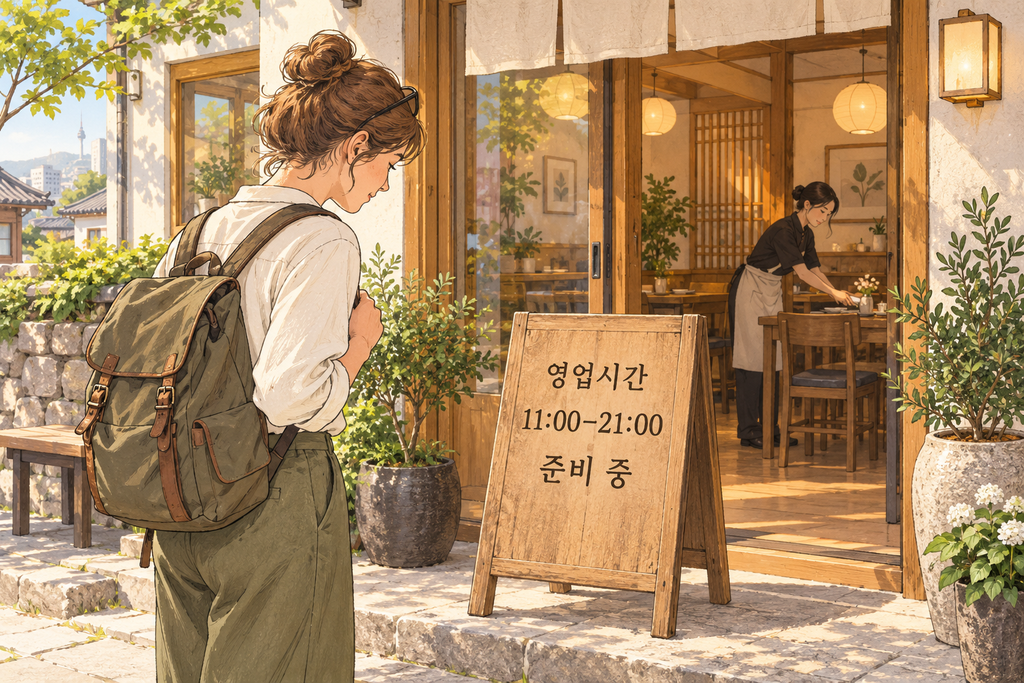
The lights are on, somebody is inside, and the opening-hours sign says the restaurant closes in the evening. Yet the person at the door tells you that you cannot order now. What did you miss?
Korean shop and restaurant signs often distinguish opening hours, a break, the last order, and a day off. Recognizing a handful of words can save you a wasted journey and help you ask a useful question when a notice is unclear.
영업시간: the business hours
영업시간 means “business hours.” A sign reading 영업시간 11:00–21:00 gives the advertised opening and closing times. The exact services available during that period may still have their own cutoffs.
To ask when a place opens, say 몇 시에 문 열어요? — “What time do you open?” To ask when it closes, say 몇 시에 문 닫아요? — “What time do you close?”
A posted schedule is a useful starting point, but a temporary notice at the entrance may announce a change for that day. Read both before assuming the usual hours apply.
브레이크 타임: a break within the opening day
브레이크 타임 is borrowed from “break time.” At a restaurant, it commonly marks an interval between lunch and dinner service. For example, 브레이크 타임 15:00–17:00 indicates a break from three to five.
How a restaurant handles guests who are already seated can vary. Do not assume you can enter, order, or remain at a table throughout the break. If you arrive near it, ask 지금 식사할 수 있어요? — “Can we eat now?”
If the answer is no, a useful follow-up is 몇 시부터 다시 주문할 수 있어요? — “From what time can we order again?” This asks about the action you need, rather than only whether the door will be open.
라스트 오더 or 주문 마감: the last time to order
라스트 오더 means “last order,” while 주문 마감 indicates the ordering cutoff. These can be earlier than closing time. A restaurant may need time to prepare the final meals and finish service.
On a sample sign reading 영업시간 11:00–21:00 / 라스트 오더 20:00, the business closes at nine, but the advertised last order is at eight. Arriving at 20:30 does not mean you still have half an hour to order.
When you arrive close to the cutoff, ask 아직 주문할 수 있어요? — “Can we still order?” The current answer from the restaurant matters more than assuming that every minute before closing is available for new orders.
휴무, 정기 휴무, and 임시 휴무
휴무 means a day or period when the business is not operating. 정기 휴무 is a regular closure, and 임시 휴무 is a temporary closure.
매주 월요일 휴무 means “Closed every Monday.” 첫째·셋째 월요일 휴무 means “Closed on the first and third Mondays.” The second notice does not say that every Monday is a day off.
If you see 오늘 임시 휴무, the business is temporarily closed today. It does not necessarily mean that it has permanently shut down. A more detailed notice may give the next opening date.
준비 중: not ready to serve yet
준비 중 means “preparing” or “getting ready.” It may appear before opening or during a pause in service. Staff can be working inside even though customers cannot yet order.
You can ask 언제 들어갈 수 있어요? — “When can we come in?” If a notice gives a return time, use that information first. Repeatedly trying the door will not make preparation finish sooner.
Compare 준비 중 with 재료 소진 — “ingredients sold out” or “ingredients used up.” The latter can mean that a dish, or that day’s food service, is no longer available. Ask what is still available rather than assuming the ordinary menu can be ordered.
Read a complete sample notice
영업시간 11:00–21:00
브레이크 타임 15:00–17:00
라스트 오더 20:00
매주 월요일 휴무
This is a fictional sign for reading practice, not the schedule of a real business. It describes a place that is closed on Mondays, has a mid-afternoon break on operating days, and stops taking orders before the advertised closing time.
Question 1: You arrive on Tuesday at 16:00. Is normal service available according to the sign?
Question 2: You arrive on Sunday at 20:30. Are you before the advertised last-order time?
Question 3: You plan to visit on Monday at noon. What should you notice?
Answers: 1. No: 16:00 is during the break. 2. No: last order was at 20:00. 3. Monday is the regular day off. Always allow for additional notices or changes when visiting an actual business.
One short conversation
Customer: 지금 주문할 수 있어요? — Can we order now?
Staff: 지금은 준비 중이에요. 다섯 시부터 주문할 수 있어요. — We’re preparing now. You can order from five.
Customer: 네, 알겠습니다. 감사합니다. — Okay, understood. Thank you.
Once you are seated, use the expressions in ordering and paying at a Korean restaurant. To practice times in sentences, review 에 for time and destination. You can check 영업, 휴무, 준비, and 마감 in the Korean–English Learners’ Dictionary.